
Cappuccino vs Latte vs Flat White: Visual Ratio Guide to Foam Depth, Cup Geometry & Flavor Balance
TL;DR: The core difference between cappuccino, latte, and flat white lies in espresso-to-milk volume ratios, foam depth and texture, and cup geometry. Cappuccino follows a 1:1:1 split (espresso:steamed milk:foam) with 1.5–2 cm dry foam in a 150–180 ml wide ceramic cup. Latte runs ~1:3 (espresso:milk) with a mere 0.3–0.5 cm wet foam in a 240–300 ml tall glass. Flat white sits at ~1:2 (espresso:milk) with 0.3–0.5 cm glossy microfoam in a 150–160 ml small ceramic cup, delivering the strongest coffee-forward flavor.
#Why the Golden Ratios of These Three Classics Matter
Standing before a specialty café menu, you see cappuccino, latte, and flat white listed side by side — all espresso plus milk — yet the experience in the cup differs dramatically. The secret sits at the intersection of extraction yield, foam microstructure, and vessel geometry. CoffeeStyle has tracked global café standards and SCA cupping protocols long enough to know: mastering these ratios lets you order with precision and recreate café-quality drinks at home, even without a commercial machine.
#Cappuccino: The 1:1:1 Layered Sculpture
Named after the Capuchin friars' brown robes, the cappuccino is defined by its three equal thirds: one-third espresso, one-third steamed milk, one-third velvety foam. Foam depth sits at 1.5–2 cm, fine enough to hold latte art without collapsing. The traditional 150–180 ml wide-rim ceramic cup lets aromatics bloom fast; sip order is foam → espresso bitterness → milk sweetness.
#Key Parameters at a Glance
| Parameter | Standard Range |
|---|---|
| Espresso volume | 25–30 ml (single) / 50–60 ml (double) |
| Steamed milk volume | Equal to espresso volume |
| Foam depth | 1.5–2 cm (dry, velvety) |
| Cup | 150–180 ml wide ceramic |
| Perceived strength | ★★★☆☆ (foam buffers intensity) |
#Latte: The 1:3 Velvet Embrace
Latte literally means milk. Its soul is abundant steamed milk wrapping the espresso — roughly a 1:3 espresso-to-milk ratio. Foam is paper-thin at 0.3–0.5 cm, microfoam fully integrated with the milk for a seamless, silky mouthfeel. Served in a 240–300 ml tall glass to showcase the caramel-to-ivory gradient. Highest milk ratio makes this the gentlest, roundest cup of the three.
#Key Parameters at a Glance
| Parameter | Standard Range |
|---|---|
| Espresso volume | 30 ml (single) / 60 ml (double) |
| Total milk volume | 90–180 ml |
| Foam depth | 0.3–0.5 cm (wet, integrated) |
| Cup | 240–300 ml tall glass |
| Perceived strength | ★★☆☆☆ |
#Flat White: The 1:2 Microfoam Intensity
Origin debated between Australia and New Zealand, the flat white is now a specialty staple. Ratio ~1:2 (espresso:milk) with microfoam just 0.3–0.5 cm thick, glossy like wet paint, emulsified into the espresso with near-zero layering. The small 150–160 ml ceramic cup locks heat and aromatics. First sip hits the espresso core — floral acidity, caramel sweetness, chocolate finish — making it the espresso lover's milk drink.
#Key Parameters at a Glance
| Parameter | Standard Range |
|---|---|
| Espresso volume | 30 ml (single) / 60 ml (double) |
| Total milk volume | 60–120 ml |
| Microfoam depth | 0.3–0.5 cm (glossy, <0.5 mm bubbles) |
| Cup | 150–160 ml small ceramic |
| Perceived strength | ★★★★☆ |
#Side-by-Side: Visual Comparison in One Table
| Dimension | Cappuccino | Latte | Flat White |
|---|---|---|---|
| Core ratio (espresso:milk:foam) | 1 : 1 : 1 | 1 : 3 : ~0 | 1 : 2 : ~0 |
| Foam depth & texture | 1.5–2 cm dry velvet | 0.3–0.5 cm wet integrated | 0.3–0.5 cm glossy microfoam |
| Cup / volume | 150–180 ml wide ceramic | 240–300 ml tall glass | 150–160 ml small ceramic |
| Perceived flavor strength | Medium (foam buffers) | Mild (milk dominates) | Strong (espresso forward) |
| Best for | Layered texture fans, latte art | Low-bitterness preference, breakfast | Espresso purists, specialty entry |
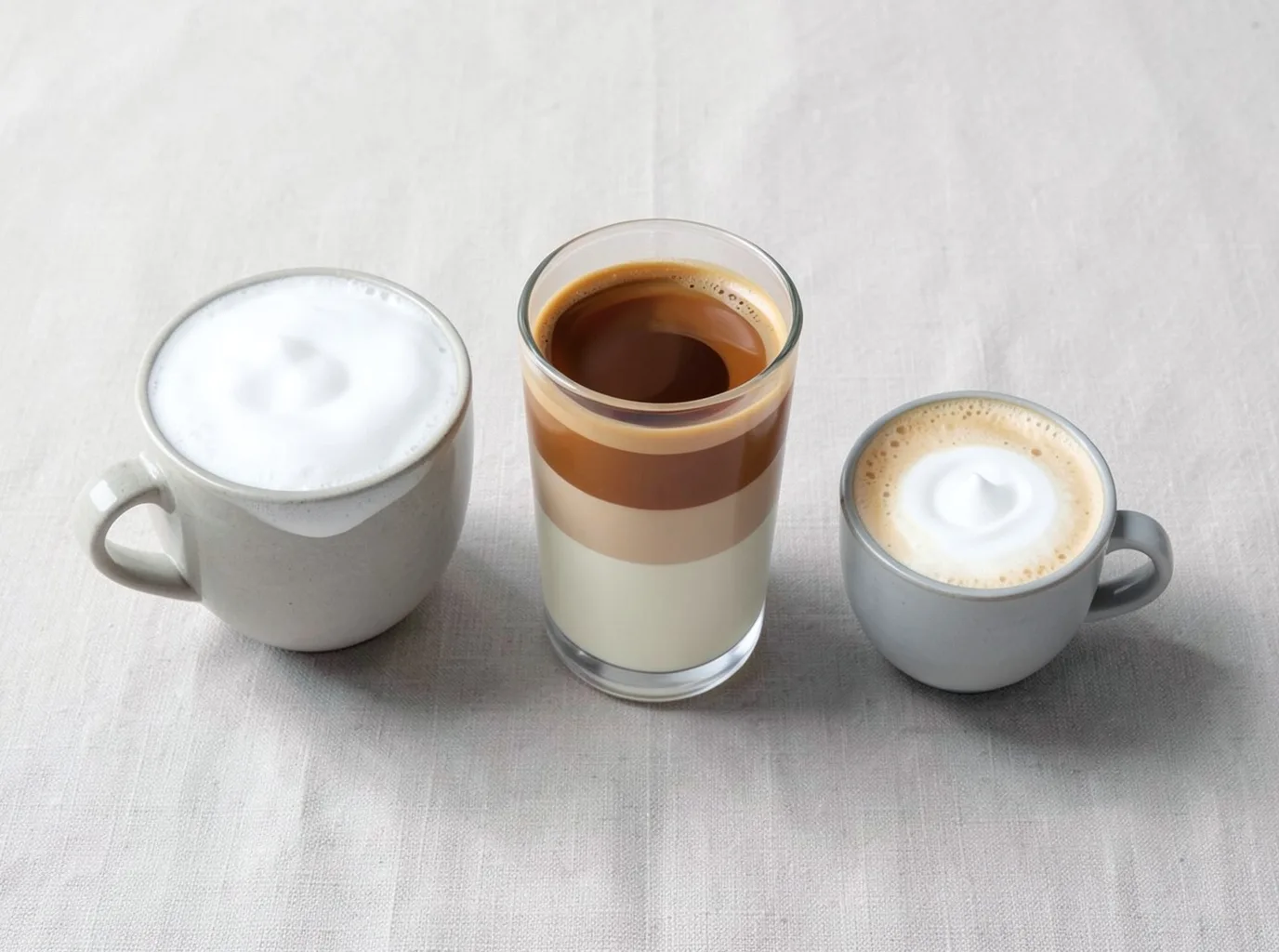
Pro tip: Same bean, same extraction — only foam texture and pour ratio change — and the flavor-wheel balance of floral acidity → caramel sweet → chocolate bitter shifts dramatically. Choose cup first, then dial ratio.
#Foam Texture Decides Flavor: Dry vs Wet vs Micro
Dry foam — larger bubbles, stiff peaks, holds shape — builds the cappuccino's cap. Wet foam — finer bubbles, fluid, merges with steamed milk — creates the latte's silk. Microfoam — bubbles <0.5 mm, mirror gloss, emulsifies with espresso — is the flat white's signature. Steam wand depth, aeration time, and milk temp (target 60–65 °C) co-determine the result. No steam wand? A French press pumped 30 seconds or a handheld frother can yield wet or microfoam; dry foam remains the hardest to replicate at home.
#No Espresso Machine? Home Workarounds That Work
- Espresso substitute: Moka pot yields ~30 ml concentrate (TDS 1.5–2.5%, close to double shot). AeroPress with fine grind, high pressure, short brew also produces high-strength coffee.
- Foam alternatives:
- French press: pour hot milk, plunge rapidly 20–30 sec for wet foam.
- Handheld electric frother: 60 °C milk, high speed 15 sec for microfoam.
- Jar shake + microwave: shake 60 sec, nuke 30 sec — coarse foam, emergency only.
- Assembly order: Cappuccino — espresso, then milk, then spoon foam. Latte & flat white — "wall-hugging" spiral pour for emulsification.
#Cup Geometry & the Third-Space Ritual
The vessel is not mere container: wide cappuccino cup releases foam aromatics; tall latte glass stages the visual gradient; thick-walled flat white cup retains heat and concentrates scent. Specialty cafés commission custom logo ceramics — weight, lip curve, handle ergonomics all serve the ritual. Next visit, read the cup before you taste; it's the silent hospitality of the third space.
#Closing: One Cup, One Life Attitude
From cappuccino's layered sculpture to latte's velvet embrace to flat white's microfoam intensity, three drinks write a philosophy of bitterness turning sweet through golden ratios. Master proportion and texture, and you hold the key to emotional customization: latte for gentle morning wake-up, flat white for midday flavor depth, cappuccino for weekend latte-art play. CoffeeStyle will keep decoding more classics' flavor maps and golden ratios — guiding you precisely through the coffee world while you savor every slow, tasteable moment.
#FAQ
#What are the exact milk-to-espresso ratios for cappuccino, latte, and flat white?
Cappuccino follows 1:1:1 (espresso:steamed milk:foam by volume). Latte runs ~1:3 (espresso:total milk including trace foam). Flat white sits ~1:2 (espresso:total milk including microfoam). Double the milk volumes when using a double shot.
#How does milk texture differ between the three drinks?
Cappuccino uses dry foam — stiff, larger bubbles that hold a peak. Latte uses wet foam — fine bubbles fully merged with steamed milk for seamless silk. Flat white uses microfoam — sub-0.5 mm bubbles, glossy like wet paint, emulsified into the espresso with almost no visible layer.
#Which drink delivers the strongest coffee flavor?
Flat white. Its 1:2 ratio and microfoam integration put espresso character front and center — floral acidity, caramel sweetness, chocolate finish — with minimal milk dilution. Caffeine content is virtually identical across all three when shot count matches.
#Can I make these drinks without an espresso machine?
Yes. Replace espresso with Moka pot or AeroPress concentrate. Create wet foam or microfoam via French press pumping or handheld frother. Dry foam for cappuccino is the toughest to nail at home, but the other two reach ~80% café quality with practice.
#What are the traditional cup sizes and why do they matter?
Cappuccino: 150–180 ml wide ceramic — supports foam structure and aroma diffusion. Latte: 240–300 ml tall glass — showcases visual layering. Flat white: 150–160 ml thick-walled ceramic — retains heat and concentrates aromatics. Cup geometry directly shapes temperature curve, aroma release path, and mouthfeel sequence.



Comments