What is the difference between Arabica and Robusta coffee?
Arabica beans: sweeter, smoother taste; grown at higher altitudes; lower caffeine content. Robusta beans: stronger, more bitter flavor; grown at lower altitudes; higher caffeine content
Coffee actually belongs to the Rubiaceae family of flowering plants. Within this family, there are over 500 genera (the biological division of family into genus) and approximately 6,000 species. This includes the coffee bean (genus Coffea)! While botanists consider all seed-bearing plants in the Rubiaceae family to be coffee plants, the coffee we drink daily comes primarily from two species—Arabica (Coffea arabica) and Canephora (Coffea canephora, also known as Robusta).
#What are Arabica and Robusta Coffee
Robusta coffee beans originate from the Coffea canephora plant, accounting for approximately 30% of global production, making it the second most popular coffee variety.
Its typical characteristics are a strong, rugged yet deep flavor profile driven by high caffeine content. Precisely because of these traits, Robusta is considered ideal for making instant coffee and is currently primarily used to produce instant coffee granules and powder.
Arabica is undoubtedly the highest-volume coffee bean variety. Originally discovered in the high-altitude forests of Ethiopia, legend has it that locals began cultivating and harvesting these beans for brewing as early as the 12th century. This variety comes from the plant Coffea arabica, and in the eyes of coffee connoisseurs, it is undoubtedly more favored and esteemed than Robusta.
A delicate, aromatic, and sweeter taste is undoubtedly a key reason for this bean's widespread popularity and recognition. Despite lower caffeine content, coffee lovers still champion Arabica beans, captivated by their wonderful flavor. In terms of production and trade, Arabica beans account for about 70% of the global market, boasting higher quality and commanding higher prices.
Arabica mainly has two major varieties: Typica and Bourbon. The variety we drink from the Canephora species is Robusta, so this major coffee category is usually collectively referred to as Robusta. In reality, coffee beans are primarily divided into two categories—Arabica and Robusta. Besides being different species within the same coffee plant family, the main differences lie in flavor and the beans' inherent characteristics.
#Core Differences Between the Two Coffee Categories
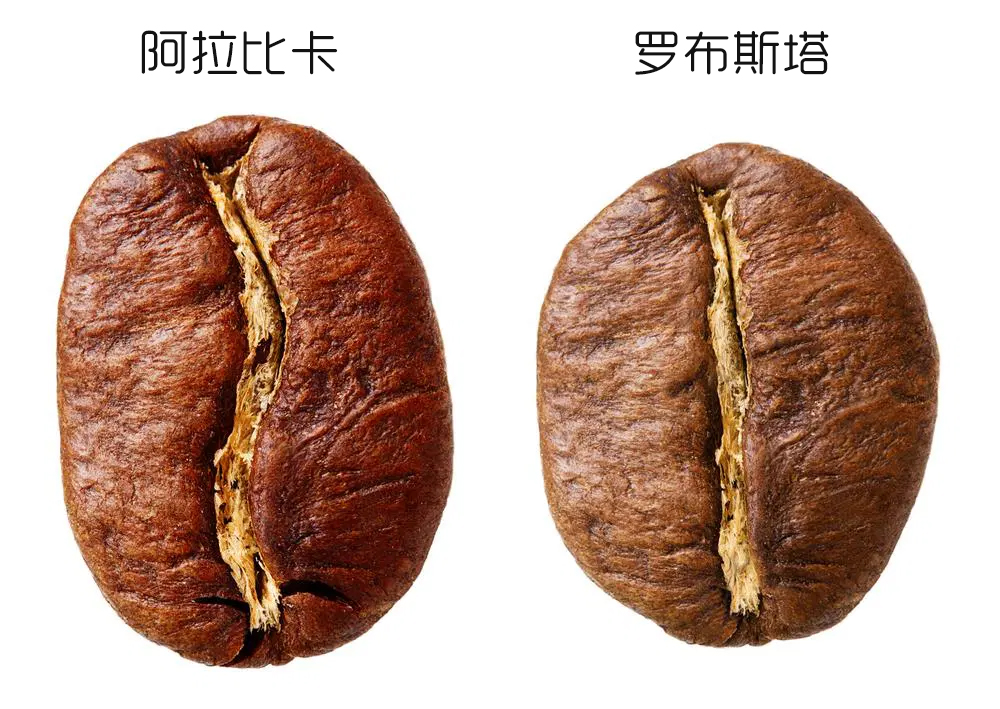
Visually, the difference between these two coffee beans is immediately apparent. Arabica beans are typically oval, flat, and oilier than Robusta, resulting in a sweeter taste with citrus notes and a hint of fruitiness. Robusta beans, on the other hand, are slightly smaller and rounder; due to lower oil content, their flavor is more intense and bitter, usually carrying a more natural earthy aroma.
Another difference lies in their caffeine content—Robusta has a higher caffeine concentration than Arabica.
Robusta beans contain 2.7% caffeine, while Arabica has only about 1.5%, nearly half that of the former.
Additionally, Arabica's sugar concentration is nearly double that of Robusta, and its lipid content is about 60% higher—these traits are likely the significant reasons consumers prefer Arabica.
True to its name, Robusta is an extremely hardy plant. From a cultivation perspective, it is easier to care for, thrives in diverse environments, and typically yields more. Due to its higher caffeine content (which is toxic to insects, serving as a chemical defense mechanism for the coffee seed), it is less susceptible to pests.
Furthermore, few people know of a third commercially cultivated coffee variety—Liberica—even though it accounts for approximately 2-3% of global coffee trade. What is Liberica? Its flavor can be described as richly fruity, unique, and exceptionally intense, benefiting from lower acidity and less bitter aroma, with a strong and lingering aftertaste.
- Arabica beans: sweeter, smoother taste; grown at higher altitudes; lower caffeine content.
- Robusta beans: stronger, more bitter flavor; grown at lower altitudes; higher caffeine content.
#Arabica vs. Robusta Beans and Their Cultivation
Robusta beans have several sub-varieties, each exhibiting unique flavor characteristics. The same is true for Arabica beans. Compared to Arabica, Robusta varieties often demonstrate stronger disease resistance and higher yields. They thrive at low altitudes where Arabica is highly susceptible to fungal and other pest infestations.
Robusta plants are more robust, reaching heights roughly double that of Arabica, and grow well in high-humidity environments. After flowering, their cherries take nearly a year to mature. Because Robusta is self-sterile, it must rely on wind, bees, and other insects for cross-pollination to reproduce.