
Coffee Flavor Profile Chart: A Bilingual Sensory Guide from Terroir to SCA Flavor Wheel
TL;DR: The coffee flavor profile chart maps global origins to specific sensory descriptors using SCA standards: Ethiopia delivers floral citrus, Kenya offers blackcurrant tomato acidity, Colombia balances nutty caramel, Brazil leads with chocolate nut bases, and Panama Geisha blooms with jasmine peach. Reading the flavor wheel moves through three concentric tiers—categories, subcategories, specific attributes—while cupping SOP quantifies aroma, flavor, body, acidity, and balance, creating a complete cognitive chain from terroir to cup.
#What Is a Coffee Flavor Profile Chart?
A coffee flavor profile chart is a visual map linking origin, variety, processing, roast level, and sensory experience. It goes beyond statistical “origin-flavor” correlations by integrating the SCA Coffee Taster’s Flavor Wheel’s professional vocabulary, letting you navigate from macro terroir to micro flavor molecules like reading a map.
We often say “terroir determines flavor,” which is truly the symphony of five variables: altitude, soil, climate, variety, and processing. Ethiopia’s Yirgacheffe at 2,000 meters forces coffee trees to synthesize more aromatic precursors; washed processing releases a bright spectrum of jasmine, bergamot, and lemon. Meanwhile, Brazil’s Cerrado plateau mechanical-harvested naturals accumulate sugars under low-altitude long sun, showing hazelnut, dark chocolate, and caramel warmth at medium-dark roasts. The chart’s value lies in translating invisible chemical reactions into language we can perceive.
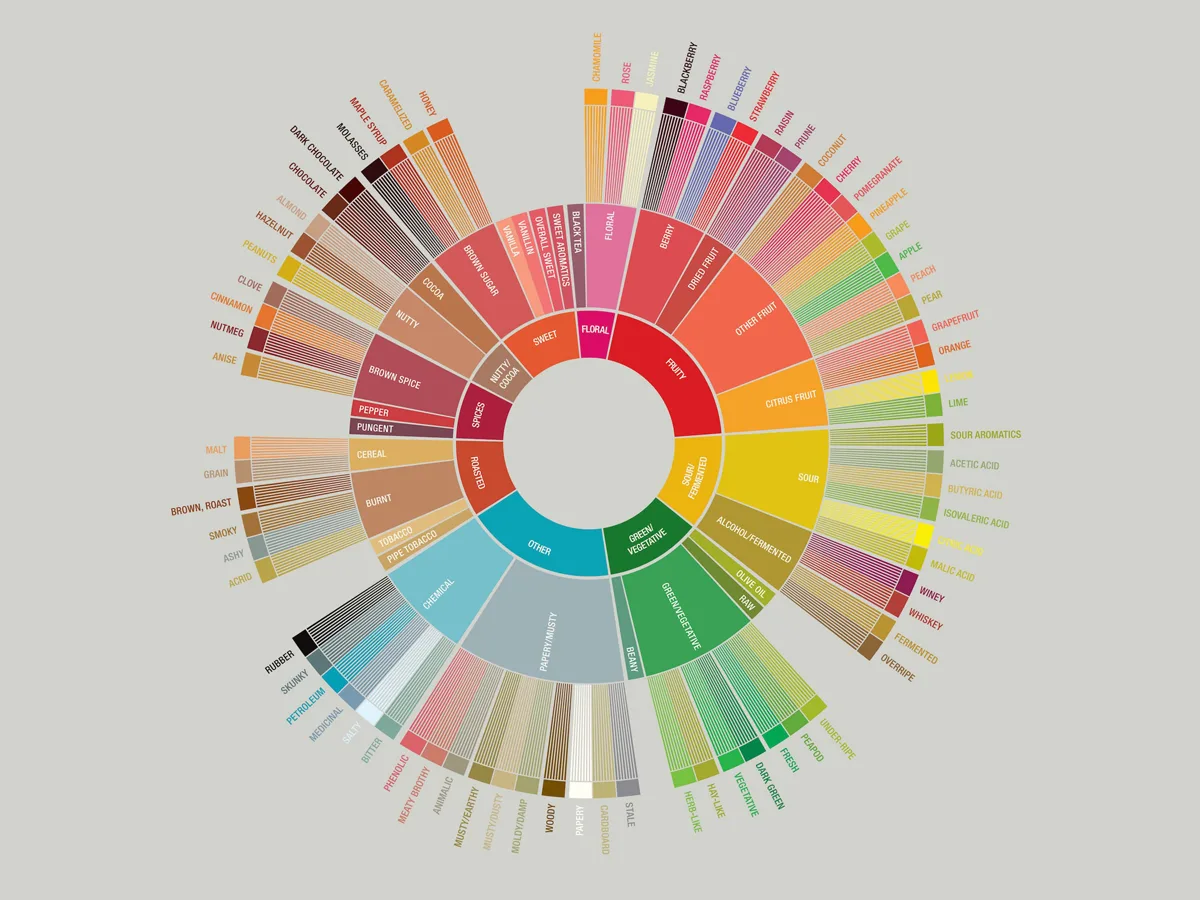
#How to Read the SCA Coffee Flavor Wheel
The SCA flavor wheel uses a three-tier concentric structure with increasing information density outward—the universal compass for cuppers.
#Tier 1: Nine Aroma/Flavor Categories
The innermost ring contains nine families: Floral, Fruity, Sour/Fermented, Green/Vegetative, Roasted/Spice, Nutty/Cocoa, Sweet, Smoky/Caramelized, Other. During cupping, first assign the category—jasmine and rose lock into “Floral”; dark chocolate and almond fall into “Nutty/Cocoa”.
#Tier 2: Subcategory Refinement
Each family splits into 2-5 subcategories. For “Fruity,” these are Berry, Dried Fruit, Citrus, Other Fruit. Kenya SL28 often hits the “Blackcurrant/Blackberry” berry subcategory; washed Panama Geisha lands precisely on “Lemon/Lime” in Citrus.
#Tier 3: Specific Sensory Attributes
The outer ring holds 100+ descriptors like “bergamot,” “lychee,” “red wine note,” “maple syrup.” Practical workflow: use category for orientation, subcategory to narrow, specific attribute to pin. Beginners can calibrate with a Le Nez du Café kit or common foods (lemon, blueberry, dark chocolate, roasted almonds).
#Advanced: Temporal Separation of Aroma and Flavor
The wheel divides into an “aroma half” (dry/wet sniff) and a “flavor half” (retronasal perception after sipping). Dry fragrance captures volatile esters and aldehydes; wet aroma releases more sugar caramelization products; sipping combines taste (sour, sweet, bitter, salty, umami) with tactile (body, astringency) for the full flavor portrait.
#How Origin Shapes Coffee Flavor: Core Origin Coordinates
Terroir is flavor’s base code. Below, using high-scoring SCA regions, we build an “origin–typical flavor–recommended roast/brew” reference table.
| Origin / Micro-region | Typical Variety / Process | Core Flavor Keywords (Wheel Path) | Recommended Roast | Golden Brew Params (V60 Example) |
|---|---|---|---|---|
| Ethiopia Yirgacheffe | Heirloom / Washed | Floral→Jasmine/Bergamot → Citrus→Lemon/Lime | Light | 92°C, 1:15, 2:15-2:30 |
| Ethiopia Sidamo | Heirloom / Natural | Fruity→Berry→Blueberry/Strawberry → Fermented→Red Wine/Rum | Light-Medium | 90°C, 1:16, 2:30-2:50 |
| Kenya Nyeri/Kiambu | SL28/SL34 / Washed | Sour/Fermented→Blackcurrant/Tomato → Citrus→Grapefruit/Blood Orange | Light | 93°C, 1:15, 2:00-2:20 |
| Colombia Huila/Nariño | Caturra/Typica / Washed | Nutty/Cocoa→Almond/Hazelnut → Sweet→Caramel/Brown Sugar | Medium-Light | 91°C, 1:16, 2:20-2:40 |
| Brazil Cerrado/Mogiana | Bourbon/Catuai / Natural/Honey | Nutty/Cocoa→Peanut/Dark Chocolate → Sweet→Caramel/Maple | Medium-Dark | 89°C, 1:17, 2:40-3:00 |
| Panama Boquete/Volcan | Geisha / Washed/Honey | Floral→Jasmine/Gardenia → Fruity→White Peach/Lychee → Sweet→Honey | Ultra-Light | 93°C, 1:15, 1:50-2:10 |
| Guatemala Antigua/Huehuetenango | Bourbon/Typica / Washed | Floral→Citrus Blossom → Fruity→Apple/Pear → Nutty/Cocoa→Almond | Medium-Light | 92°C, 1:16, 2:20-2:40 |
| Costa Rica Tarrazú/West Valley | Caturra/Catuai / Honey/Anaerobic | Sweet→Tropical Fruit/Pineapple → Sour/Fermented→Sake/White Wine | Light-Medium | 91°C, 1:15, 2:10-2:30 |
| Indonesia Mandheling/Lintong | Typica/Ateng / Wet-Hulled | Smoky/Caramelized→Tobacco/Cedar → Nutty/Cocoa→Dark Chocolate → High Body | Dark | 88°C, 1:16, 3:00+ |
| China Yunnan Pu'er/Baoshan/Dehong | Catimor/Typica / Natural/Honey | Fruity→Yellow Peach/Mango → Sweet→Brown Sugar/Honey → Mild Acidity | Medium-Light | 90°C, 1:16, 2:30-2:50 |
Practical Tip: Same origin, vastly different flavors due to microclimate and process. Yirgacheffe washed is “floral citrus”; natural becomes “berry wine.” Always verify the process label (Washed/Natural/Honey/Anaerobic)—it’s the second decisive factor for flavor.
#Common Coffee Tasting Notes: Vocabulary Library from Beginner to Advanced
Building a personal flavor vocabulary transforms “drinking coffee” into “tasting coffee.” Below, high-frequency descriptors organized by wheel family with typical origin/process associations.
#Floral
- Jasmine/Bergamot: Signature top notes of washed Panama Geisha, Ethiopia washed
- Gardenia/Orange Blossom: Common in Costa Rica honey, Yunnan natural
- Rose/Lavender: Ethiopia high-altitude washed, Yemen heirloom
#Fruity
- Citrus (Lemon/Lime/Blood Orange/Grapefruit): Kenya, Ethiopia washed, Panama Geisha—high-altitude washed “acidity business card”
- Berry (Blueberry/Blackberry/Raspberry/Strawberry): Ethiopia natural, Yemen, Rwanda natural—anaerobic/natural fermentation produces esters
- Stone/Tropical (White Peach/Lychee/Mango/Pineapple/Passionfruit): Panama Geisha honey, Costa Rica anaerobic, Yunnan honey
- Dried Fruit (Raisin/Date/Fig/Red Wine Note): Brazil natural, Indonesia Mandheling, Yemen natural
#Nutty/Cocoa/Sweet
- Almond/Hazelnut/Peanut/Walnut: Colombia, Brazil, Guatemala washed/honey base notes
- Dark Chocolate/Milk Chocolate/Cocoa Powder/Caramel/Maple/Brown Sugar/Honey: Universal in medium-dark roasts; prominent in Brazil, Indonesia, China Yunnan
#Special/Fermented/Roasted Spice
- Red Wine/Whiskey/Rum/Sake Note: Anaerobic, carbonic maceration, over-fermented natural
- Spice (Cinnamon/Clove/Cardamom/Pepper): Indonesia wet-hulled, India Monsoon Malabar, dark roast blends
- Tobacco/Cedar/Pine Smoke/Caramelized Smoke: Mandheling, dark espresso blends
#Green/Vegetative/Sour-Fermented (Often Misread as Defects)
- Grass/Green Apple/Green Pepper/Tomato Leaf: Light roast Kenya, Ethiopia ultra-high washed—belongs to “Green/Vegetative,” not a defect
- Acetic/Fermented Sour/Kombucha Note: Typical of anaerobic/anaerobic natural; distinguish “clean fermentation” from “dirty fermentation”
Pitfall Guide: “Earthy/moldy/rubbery/phenolic/medicinal” are SCA defect flavors, usually from overripe picking, improper drying, or moisture damage. Defect deductions (Taint 2 pts, Fault 4 pts) directly cut final score.
#Cupping in Practice: Quantifying Your Flavor Map with SCA Standards
Cupping uses the standardized SCA Cupping Protocol to evaluate quality—a universal language. Master it to turn subjective perception into reproducible data.
#Standardized Parameters (SCA 100-Point Core Items)
- Fragrance/Aroma - Smell dry grounds immediately after grind, break crust at 4 min for wet aroma (10 pts each)
- Flavor - Sip across palate, combine retronasal perception (10 pts)
- Body - Tactile weight, viscosity in mouth (10 pts)
- Acidity - Brightness, complexity, pleasantness (10 pts)
- Balance - Harmony across dimensions, no jarring gaps (10 pts)
- Sweetness/Clean Cup/Overall - 10 pts each
- Defect Deductions - Taint/Fault subtraction
#5-Step Cupping SOP
- Prep: Roasted 8-24 hrs prior, medium-fine grind (70-75% pass China #20 sieve), 8.25g/150ml, 93°C water, TDS 125-175 ppm
- Dry Smell: Within 15 min of grind, log category→subcategory→specific
- Pour/Wet Smell: Pour to 150ml, 4 min steep, break crust, deep inhale
- Break/Scrape: Break at 4 min, skim fines at 8-10 min
- Taste: 10-20 min multiple slurps as temp drops (hot→warm→cool), log flavor, acidity, body, sweetness, clean cup, balance separately
#Advanced: Build Your Personal Flavor Coordinate System
- X-axis: Roast level (ultra-light → dark)
- Y-axis: Fermentation intensity (washed → honey → natural → anaerobic)
- Bubble size: Altitude/variety scarcity
- Color: Continent of origin
Plot each cupped coffee with flavor keywords. After six months, you’ll own a “flavor star chart” that predicts new beans’ profiles.
#How Roast and Brew Reshape Flavor Expression
Same bean, each roast degree deeper shifts the wheel position outward: light locks “floral/citrus/green vegetative,” medium releases “caramel/nut/cocoa,” dark dominates “smoky/caramel/bittersweet.”
#Roast-Flavor Quick Map
| Roast Level | Agtron Range | Dominant Wheel Zone | Target Extraction Yield |
|---|---|---|---|
| Ultra-Light/Light | 95-85 | Floral, Citrus, Green Vegetative, High Acid | 19-21% |
| Medium-Light | 85-75 | Stone Fruit, Berry, Caramel, Nut, Balanced Acid | 19-20% |
| Medium | 75-65 | Cocoa, Nut, Caramel, Brown Sugar, Body↑ | 18-20% |
| Medium-Dark/Dark | 65-55 | Dark Chocolate, Smoky, Caramel, Bittersweet, Low Acid | 17-19% |
#Brew Parameter Micro-Tuning
- Temperature: Each 1°C drop reduces perceived acidity ~5%, increases perceived body ~3% (light roast 92-94°C, dark 88-90°C)
- Grind: One notch finer raises extraction 1-1.5%, increases body, but risks off-flavors
- Ratio: 1:15 richer, 1:17 brighter; adjust within 1:14-1:18 per flavor target
- Time: V60 target 2:00-3:00; overtime over-extracts bitterness, undertime yields sour thinness
Health Note: Caffeine-sensitive drinkers can choose Swiss Water decaf or low-caf varieties (e.g., Laurina), or reduce extraction time, lower temperature, increase ratio to limit caffeine release. Pregnancy guideline: <200mg caffeine/day (≈1-2 pour-over cups).
#Coffee Flavor Profile Chart FAQ
#How to Quickly Learn to Read the Coffee Flavor Wheel?
Start from the nine center categories. Create olfactory anchors with real foods: jasmine tea for “Floral→Jasmine,” blueberry jam for “Fruity→Berry→Blueberry,” roasted almonds for “Nutty/Cocoa→Almond.” Cup 1-2 single origins weekly, forcing wheel annotations; three months builds a functional vocabulary.
#What Is the Flavor Divide Between Specialty and Commercial Coffee?
SCA cupping ≥80 points defines specialty coffee: distinct identifiable characteristics, no defects, pleasant acidity, notable sweetness, high balance. Commercial coffee often blends multi-origin, roasts dark to mask defects, converging on “bitter/smoky/burnt” with no origin identity.
#Why Does the Same Origin Show Huge Flavor Variance?
Micro-region altitude differences of 100m, process variation (washed vs natural), variety difference (Geisha vs Typica), roast curve shifts—all move the flavor spectrum. Bean selection requires all four: “origin + process + variety + roast level.”
#How to Replicate Café-Level Flavor Layers at Home?
Control three variables: water (TDS 125-175ppm, soft), grind uniformity (flat burr grinder), pour stability (gooseneck ±2ml/s). Replication formula: copy café parameters → single-variable tweak → log flavor change → lock personal golden ratio.
#How to Build a Personal Coffee Flavor Journal System?
Use a structured template: date/bean/roast/process/brew params/dry aroma/wet aroma/flavor keywords (wheel path)/acidity/body/sweetness/balance/total score/mood tag. After 50+ entries, your palate map gains predictive power for new beans.
#Closing: The Flavor Map Ends in a Cup That’s Yours
When we plot Ethiopia’s florals, Kenya’s blackcurrant, Panama’s jasmine peach, Yunnan’s peach honey on the wheel; when we lock extraction at 18-22% golden zone and quantify each sip’s sour-sweet-bitter-salty on SCA forms—we don’t get a cold data sheet. We get a key that unlocks “emotional customization” on demand.
Morning clarity calls for Kenya washed, tomato acidity waking the palate. Afternoon stolen leisure deserves Brazil natural, hazelnut caramel warmth for daydreaming. Midnight solitude suits Mandheling in a copper pot, tobacco cedar spiraling in steam like divination patterns.
CoffeeStyle believes: the flavor map is not the destination, but the starting point. It guides you through the labyrinth of terroir, roast fire, brew parameters—to arrive at the moment that belongs only to you. One cup, one life attitude.
If you want to systematically build flavor cognition from novice to blind-tasting, explore our Specialty Coffee Beginner's Guide: 30-Day Roadmap from Novice to Blind-Tasting Flavors. For a flavor coordinate map of 20 core origins, see Coffee Flavors by Region: A Flavor Coordinate Map of 20 Core Origins.
May every cup of yours read the land’s whisper in bitterness turned sweet.




Comments