Cold Brew Coffee Recipe: 5 Methods Compared & Golden Ratios by Roast Level
TL;DR: Cold brew trades heat for time—steep coffee at 1:10–1:15 ratio for 12–24 hours at room temp or in the fridge, then filter. The device only changes filtration ease and mouthfeel; flavor is driven by roast level and recipe matching.
#Cold Brew Coffee Recipe: Starting with a Wait
If you open the fridge at 6 a.m. and see a bottle of amber liquid resting quietly in a glass jar, as if time itself has been condensed into a patient hue—that is the ritual cold brew leaves in urban life. Unlike the instant explosion of hot brewing, cold brew lets water molecules slowly penetrate coffee cell walls at low temperature, extracting only soluble sugars, oils, and aromatics while leaving tannins and harsh bitterness in the grounds. Over the past six months, the CoffeeStyle team tested the same Ethiopian natural-process beans across five devices: French press, ice drip tower, cold brew bag, French press filtration (double-screen), and automatic cold brewer. The result: device-driven flavor differences are far smaller than the impact of roast level and brew parameters.
#Cold Brew Coffee Ratio: Golden Recipes by Roast Level
Ratio is the skeleton of cold brew flavor. Following SCA Gold Cup theory—targeting 18–22% extraction yield and 1.15–1.35% TDS—we cupped repeatedly to derive the following golden ratio chart per roast level (scaled to 1 L final yield):
| Roast Level | Coffee Dose | Water | Ratio | Grind Size | Expected Flavor Notes |
|---|---|---|---|---|---|
| Light | 85 g | 1000 ml | 1:11.8 | Medium-coarse (sea salt) | White florals, citrus, tea-like, bright acidity |
| Medium | 75 g | 1000 ml | 1:13.3 | Medium-coarse | Caramel, nuts, chocolate, rounded sweetness |
| Dark | 65 g | 1000 ml | 1:15.4 | Coarse (coarse sea salt) | Cocoa, smoke, winey, heavy body |
Tip: Too fine = over-extraction & mud; too coarse = thin flavor. Use a flat burr grinder; if only conical, set to coarsest pour-over notch then back off half a step.
#How Long to Steep Cold Brew? Room Temp or Fridge?
Time and temperature are coupled variables. We tested side-by-side at 20–22 °C (room) and 4 °C (fridge):
#Room Temperature (20–22 °C)
- 12 hrs: ~16% extraction, lean, slightly hollow finish.
- 16 hrs: ~19% extraction, best sweet-acid balance, most layered.
- 24 hrs: >22% extraction, woody off-notes appear.
#Refrigerator (4 °C)
- 18 hrs: Equivalent to ~14 hrs room temp, clean but 15% less body.
- 24 hrs: Matches ~16 hrs room temp; ideal for overnight start, morning harvest.
Strategy: Choose room temp 16 hrs for flavor completeness; choose fridge 24 hrs for convenience and oxidation stability. Both require opaque, sealed vessels.
#Cold Brew vs. Ice Drip: 5 Devices Hands-On Comparison
Cold brew = immersion; ice drip = slow percolation. The former keeps water and grounds in full contact; the latter drips ice water at ~1 drop/sec through the bed. Using the same washed Mandheling (medium roast), cupping scores broke down as follows:
![Side-by-side comparison of five cold brew coffee devices in a modern kitchen: French press, ice drip tower, cold brew bag in jar, French press filter, automatic cold brew machine, each with resulting]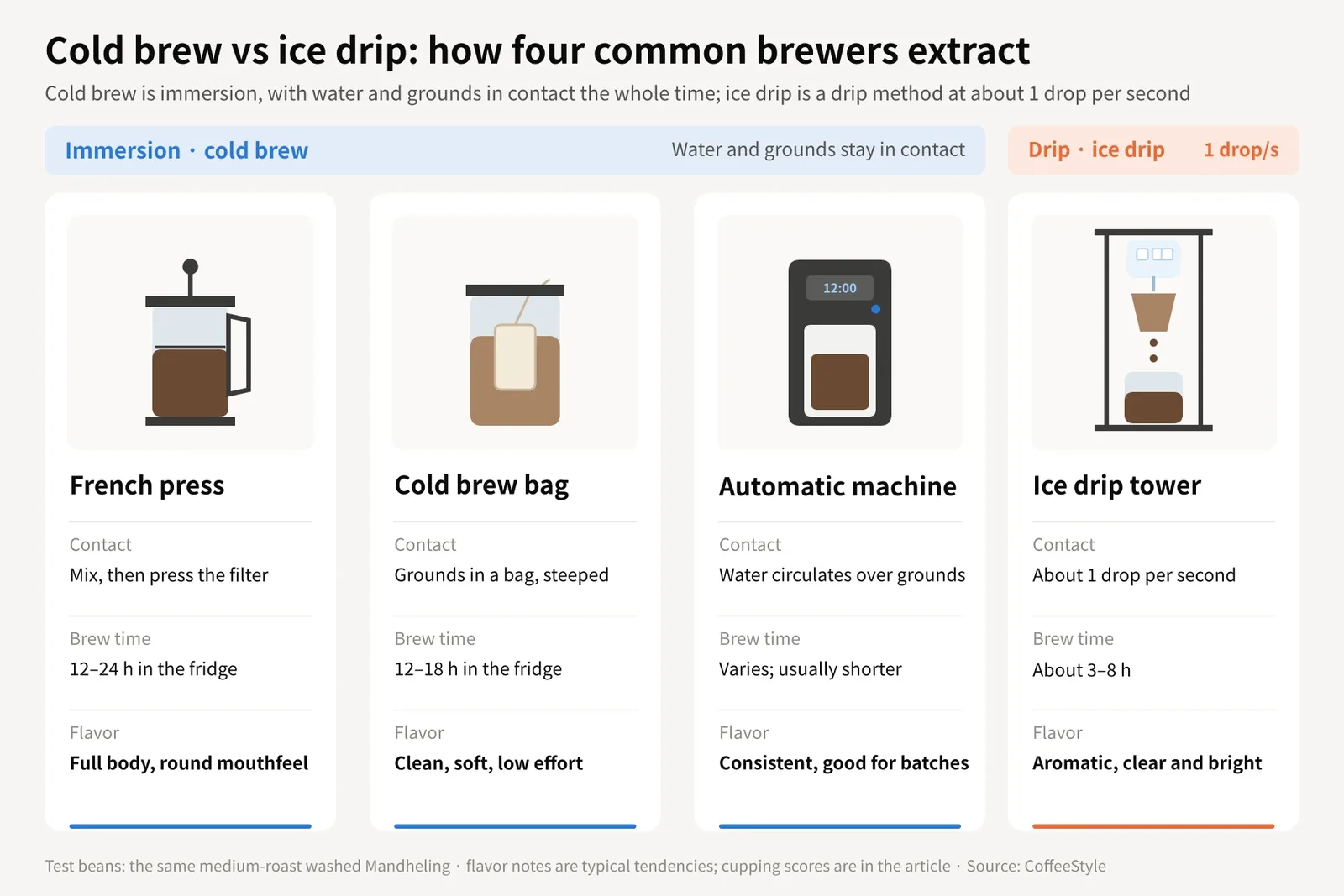
| Device | Principle | Difficulty | Filtration Efficiency | Body | Off-Note Control | Best For |
|---|---|---|---|---|---|---|
| French Press | Immersion + metal mesh | ★☆☆ | Medium | High | Medium | Beginners, home staple |
| Ice Drip Tower | Ice water percolation | ★★★ | High | Medium | High | Clean-cup chasers, ritual lovers |
| Cold Brew Bag | Immersion + paper/non-woven bag | ★☆☆ | High | Medium-low | High | Office, travel, low effort |
| Double-Screen French Press | Immersion + dual metal mesh | ★★☆ | Medium-high | High | Medium | Enthusiasts, texture seekers |
| Automatic Cold Brewer | Recirculation / pressure | ★☆☆ | Very High | Adjustable | Very High | Cafés, consistent batch output |
Tasting Notes:
- French press retains most oils, thickest mouthfeel, slight silt finish.
- Ice drip yields clearest liquor, brightest acidity, highest florals, lowest body.
- Cold brew bag is cleanest workflow, flavor sits between the two above, great for batch prep.
- Double-screen French press balances body and clarity—our team's highest repeat-purchase device.
- Automatic brewer delivers in 2 hrs with superb consistency, but high cost and fiddly cleaning.
#Cold Brew Shelf Life & Storage
Finished concentrate at 4 °C, dark, nitrogen-flushed or vacuum-sealed:
- Concentrate: 7 days max before >10% flavor decay (measured by floral retention).
- Diluted (1:1 water/milk): Consume within 24 hrs.
- Spoilage signs: Surface oil film, sharp vinegar acidity, increased haze/sediment.
Pro storage hack: Decant into 300 ml amber bottles, flush with food-grade nitrogen, refrigerate—extends to 10 days at >90% flavor integrity. No nitrogen? One-way valve coffee bags slow oxidation.
#Which Roast Level Is Best for Cold Brew?
No single "best"—only the best match for your palate.
- Light natural/honey: High-altitude Ethiopia, Panama Geisha. Cold brew maximizes florals/fruit, acidity softens to tea-like. Drink straight or as Cold Brew Tonic.
- Medium washed/wet-hulled: Colombia, Guatemala, Mandheling. Nut-caramel sweetness shines; ideal base for milk drinks (cold brew latte, Flat White).
- Dark charcoal/wet-hulled: Mandheling G1, Brazil dark. Low acid, high body, chocolate-smoke intensity; great with milk or as cocktail base.
Pitfalls to avoid: Commercial blends, stale beans (>60 days post-roast), extremely dark carbonized roasts—these yield hollow, stale, or harshly bitter cold brew.
#Advanced Play: Second Extraction & Mood Customization
After first steep, reuse the same grounds with fresh water for 8 hrs (room temp). The "second extract" runs ~0.4% TDS—whisper-thin but retaining subtle sweetness. Uses:
- Coffee ice cubes—melt without diluting main batch.
- Baking syrup base—reduce with sugar for cake soaks.
- Cocktail lengthener—lowers ABV while keeping coffee aroma.
Mood-customization micro-experiment: At hour 8 of steep, add 2 g orange peel, 1 cinnamon stick, or 3 cardamom pods. They layer complexity without masking terroir—what we call a "mood customization" moment.
#Closing: Brew Time into Your Own Cup
Cold brew's magic isn't in owning an ice drip tower or automatic brewer—it's in gifting yourself 16 hours of waiting. When that amber liquid slides down your throat, the sweetness and clarity are a symphony of terroir, roast, grind, water, and time. CoffeeStyle hopes this hands-on comparison and golden ratio chart becomes your reliable map. Tonight, try loading a French press by your bedside, add grounds and water before sleep, and wake to a cup where bitterness has turned to grace.
#FAQ
#What is the cold brew coffee ratio in grams?
Standard starting ratio is 1:10 to 1:15 (coffee:water by weight). Light roast 1:11–1:12, medium 1:13–1:14, dark 1:15–1:16. For 1 L yield: light ~85 g, medium ~75 g, dark ~65 g.
#How long should cold brew steep? Room temp or fridge?
Room temp 16 hrs for fullest flavor; fridge 4 °C needs 24 hrs for comparable extraction. Both require opaque, sealed containers.
#What is the difference between cold brew and ice drip?
Cold brew = immersion (full contact), higher body, more oils. Ice drip = slow percolation (1 drop/sec), clearer cup, brighter acidity, more florals.
#How long does cold brew last? How to store?
Concentrate keeps 7 days in fridge with <10% flavor loss. Decant into amber bottles, nitrogen-flush or use one-way valve bags. Diluted version: consume within 24 hrs.
#Which roast level is best for cold brew?
Light = floral fruit tea notes; medium = balanced caramel nut; dark = heavy chocolate smoke. Choose by preference; avoid stale or over-roasted beans.