Coffee Flavors by Region: A Flavor Coordinate Map of 20 Core Origins
TL;DR: The Coffee Flavors by Region map uses a first-of-its-kind "Flavor Coordinate System"—plotting acidity, sweetness, and body against altitude, process, and variety—to turn 20 core origins into a filterable, clickable map that links straight to deep-dive reports.
#What Is the "Flavor Coordinate System"?
We break coffee flavor into three measurable axes: Acidity (brightness & complexity), Sweetness (caramel, fruit sugar, honey), and Body (weight & texture) on the horizontal plane. The vertical plane stacks Altitude, Process (Natural/Washed/Honey), and Variety (Typica, Bourbon, Geisha, etc.). Every origin lands in a specific quadrant, creating a visual, searchable Coffee Flavors by Region map.
Quick glossary:
- Single Origin: Coffee traceable to one farm, co-op, or micro-climate.
- Flavor Wheel: SCA’s 110+ standardized descriptors for calibrated cupping.
- Cupping: SCA protocol—8.25 g / 150 ml, 93 °C, 4 min break, scored on a 100-point sheet.
#What Does Ethiopian Coffee Taste Like?
Ethiopia, coffee’s birthplace, holds the richest heirloom gene pool.
#Yirgacheffe
- Coordinates: High altitude (1,900–2,200 m) + Washed/Natural + Heirloom
- Profile: White florals, lemon, jasmine, bergamot; tea-like brightness, delicate sweetness
- Brew guide: V60 1:15.5, 92 °C, three-pour, target 20 % extraction
#Sidamo
- Coordinates: Mid-high altitude (1,700–2,000 m) + predominantly Natural
- Profile: Blueberry, red wine, tropical fruit; medium-high body, juicy acidity
#Guji
- Coordinates: Emerging micro-region, 2,000 m+, Washed & Anaerobic Natural
- Profile: Peach, apricot, honey sweetness; rounded acidity
Pro tip: "Heirloom" on the bag means mixed native varieties—maximum flavor diversity for explorers.
#How Do Yunnan and Brazil Coffees Differ?
| Dimension | Yunnan (Baoshan/Pu’er/Dehong) | Brazil (Minas Gerais/Cerrado) |
|---|---|---|
| Altitude | 1,000–1,600 m | 800–1,200 m |
| Main Varieties | Catimor, Typica, Bourbon | Catuai, Catucai, Acaiá |
| Common Processes | Washed, Natural, Honey, Anaerobic | Pulped Natural, Natural, Mechanical Washed |
| Acidity | Bright citrus, green apple; finer at higher elevation | Low; nutty, chocolate, caramel |
| Body | Medium, silky | High, syrupy |
| Flavor Coordinates | (High Acidity, Med Sweetness, Med Body) | (Low Acidity, High Sweetness, High Body) |
One-line rule: Choose Yunnan Washed for "bright fruit acid + florals"; choose Brazil Natural/Pulped Natural for "low-acid nut-chocolate + heavy sweet body."
Internal link: Deep-dive Yunnan in Coffee Origins Decoded: A Flavor Map of the World's Seven Major Specialty Coffee Regions and Brazil volume trends in 2023 Year Ten Largest Coffee Producing Countries, Brazil Tops.
#How Do Natural and Washed Processes Shape Flavor?
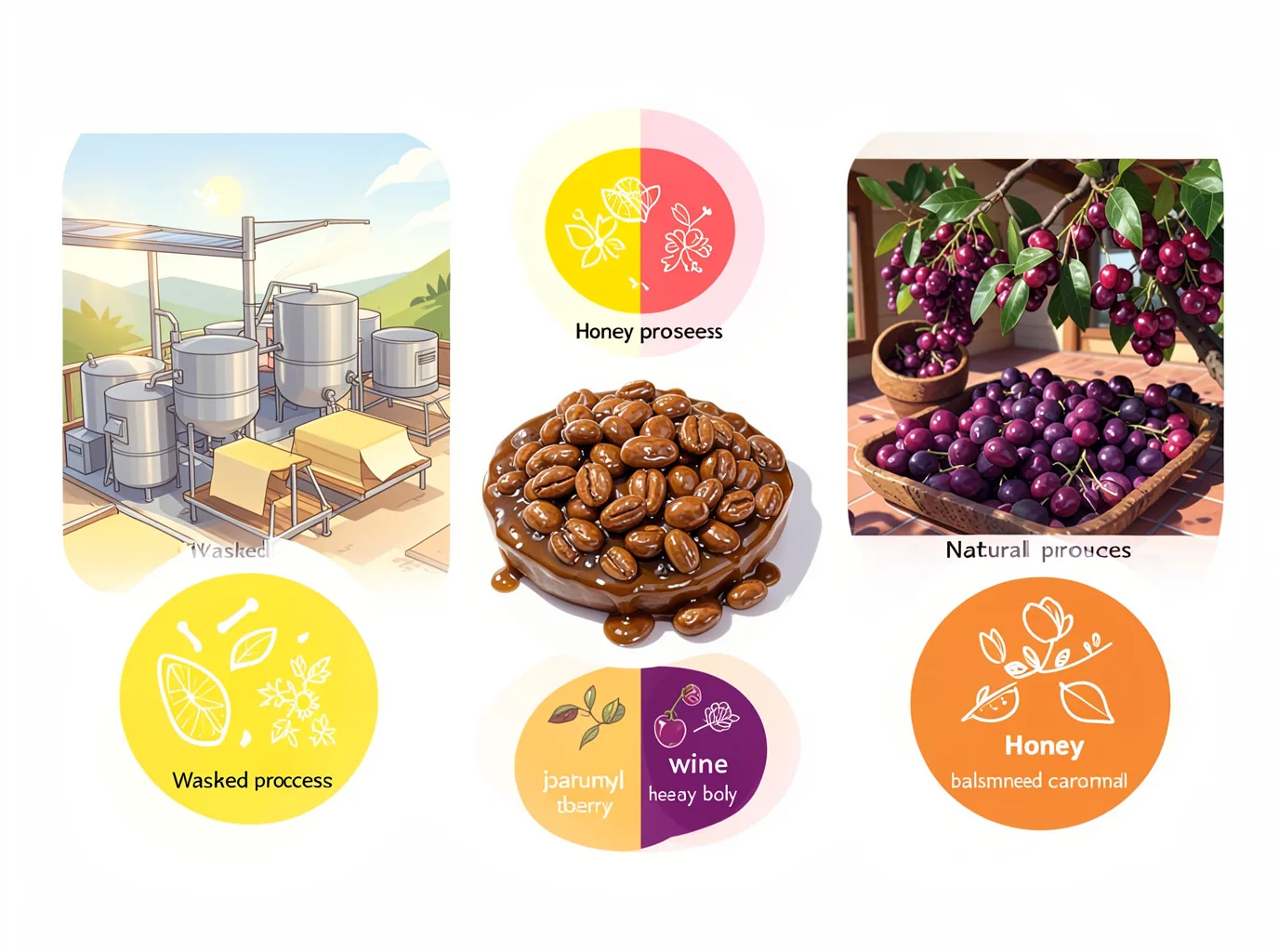
Process is the strongest "knob" on the vertical axis of the Flavor Coordinate System.
#Washed
- Depulp → Ferment in tanks (12–36 h) → Wash → Dry
- Flavor projection: Acidity ↑↑, Clarity ↑, Sweetness medium, Body ↓
- Typical origins: Kenya, Colombia Washed, Ethiopia Washed, Panama Geisha Washed
#Natural
- Whole cherry dried intact (15–25 days) → Hull
- Flavor projection: Sweetness ↑↑, Body ↑, Fermented fruit notes (berry, wine), Rounded acidity
- Typical origins: Ethiopia Natural, Brazil Natural, Yunnan Natural, Yemen
#Honey
- Depulp, retain variable mucilage → Dry directly (White/Yellow/Red/Black by mucilage amount)
- Flavor projection: Balanced acidity & sweetness, creamy texture
- Typical origins: Costa Rica, Panama, El Salvador, Yunnan
Further reading: Why Is Natural Coffee Sweeter Than Washed?
#How to Read Origin Info and Buy Beans You’ll Love
#5-Step Bean Selection
- Set your coordinates: Plot your preference zone on the map (e.g., High Acidity + Med Sweetness + Low Body)
- Lock origin: Match quadrant → Kenya SL28/34, Yirgacheffe Washed, Panama Geisha Washed
- Check the label: Must show Region + Altitude + Variety + Process + Roast Level + Roast Date (none missing)
- Verify cupping: SCA 85+ = specialty baseline; Flavor Wheel descriptor overlap > 60 % with your taste
- Micro-lot trial: Buy 100–200 g, brew at Golden Ratio (1:15–1:16.5) to confirm
#Red-Flag Checklist
- ❌ Only "Arabica" no region → Commercial blend
- ❌ Roast date > 30 days → Aroma faded
- ❌ "Espresso Blend" without single-origin traceability → Not for pour-over
#Kenya, Colombia, Panama Geisha—What Are Their Signatures?
#Kenya
- Coordinates: High altitude (1,600–2,100 m) + SL28/SL34/Ruiru 11 + Double Washed
- Profile: Blackcurrant, tomato acidity, grapefruit, black tea; razor-sharp brightness, often SCA 87+
- Brew tip: Kalita Wave 1:16, 90 °C, fines control, target 19–20 % extraction
#Colombia
- Coordinates: Three Andean cordilleras (1,200–2,000 m) + Caturra/Castillo/Geisha + Washed/Honey
- Profile: Red apple, caramel, nuts, cocoa; textbook balance
- Grades: Excelso (screen 15–16) vs Supremo (screen 17+); Supremo = more uniform
#Panama Geisha
- Coordinates: Boquete/Volcán (1,600–2,000 m) + Geisha variety + Washed/Natural/Anaerobic
- Profile: Jasmine, peach, bergamot, black tea; explosive aromatics, elegant lingering acidity
- Price anchor: Jaramillo/Elida auction lots > $1,000/lb; daily lots $80–150/lb
Internal link: Brazil climate deep-dive at Climate Factors Affecting Coffee Cultivation in Brazil.
#Advanced Map Use: "Mood-Matching" Your Beans
Coffee isn’t just flavor—it’s mood curation.
| Mood Scenario | Target Coordinates | Example Origins | Ritual |
|---|---|---|---|
| Morning Wake-Up | High Acid, Med Sweet, Low Body | Kenya Washed, Yirg Washed | V60 pour-over, listen to the bloom |
| Afternoon Focus | Med Acid, High Sweet, Med Body | Colombia Honey, Yunnan Washed | Temp-controlled kettle + ceramic dripper |
| Evening Solo | Low Acid, High Sweet, High Body | Brazil Natural, Mandheling, Yemen Natural | French Press 1:12, sip 20 min |
| Social Share | High Aroma, Balanced Acid/Sweet, Med Body | Panama Geisha Washed, CR Red Honey | Cold drip, serve in wine glasses |
We keep the interactive map live at CoffeeStyle—click any origin for farm stories, cupping notes, brew sheets, and grower interviews.
#Closing: One Map, One Journey
The Coffee Flavors by Region map is a starting line, not a finish line. When you locate your resonant "star," hear the bag’s sigh, watch hot water bloom the grounds into fragrance—terroir, variety, process, roast, brew—all converge into that single sip of bitterness turned sweet, a liquid philosophy of patience.
Next step: Open the map, pick your mood coordinates, brew the next cup.
#FAQ
#What Does Ethiopian Coffee Taste Like?
Ethiopia is coffee’s birthplace with the richest heirloom diversity. Yirgacheffe Washed gives white floral, lemon, tea-like brightness; Sidamo Natural brings blueberry, red wine, juicy acidity; Guji adds peach, apricot, honey sweetness with rounded acidity. The common thread: high-elevation brilliance and complex floral-fruit aromatics.
#How Do Yunnan and Brazil Coffees Differ?
Yunnan sits higher (1,000–1,600 m), focuses on Catimor/Typica/Bourbon with Washed/Honey/Anaerobic, yielding citrus-floral brightness. Brazil sits lower (800–1,200 m), grows Catuai/Catucai mostly Pulped Natural/Natural, delivering nut-chocolate comfort, low acid, high sweetness, heavy body. Choose Yunnan for lift, Brazil for comfort.
#How Do Natural and Washed Processes Affect Flavor?
Washed removes mucilage via fermentation → sharp, clean acidity, medium sweetness. Natural dries whole cherry → sugar migrates inward → berry/wine notes, high sweetness & body. Honey retains partial mucilage → balanced acidity/sweetness, creamy texture. Process is the strongest vertical-axis lever on the Flavor Coordinate System.
#How Do I Read Origin Info to Buy Beans I’ll Like?
Follow the 5-step method: 1) Plot your flavor coordinates. 2) Match the quadrant to origins. 3) Demand full labels (Region, Altitude, Variety, Process, Roast Level, Roast Date). 4) Cross-check SCA score ≥ 85 and Flavor Wheel descriptor overlap > 60 %. 5) Trial 100–200 g at Golden Ratio (1:15–1:16.5). Skip bags missing origin, roasted > 30 days ago, or labeled only "Espresso Blend."
#What Are the Signatures of Kenya, Colombia, and Panama Geisha?
Kenya SL28/34 Double Washed: blackcurrant, tomato acidity, grapefruit, black tea—razor brightness, often 87+. Colombia Andean Washed/Honey: red apple, caramel, nuts, cocoa—textbook balance. Panama Geisha: jasmine, peach, bergamot, black tea—explosive aromatics, elegant acidity, premium price.