
Pour Over Coffee Tutorial: Master the "Coffee Stylesheet" for Café-Quality Brews at Home
TL;DR: The pour over coffee tutorial centers on a repeatable "Coffee Stylesheet" — fix ratio at 1:15, water at 90–93 °C, grind like sea salt, three-stage pour with a V60-style dripper and gooseneck kettle — so beginners can consistently hit the 18–22 % golden extraction window and café-quality balance.
#What Is a "Coffee Stylesheet" and Why Do Beginners Need It?
Treat every brew as a line of maintainable code: gear, parameters, actions, and flavor expectations made explicit on a printable decision card. CoffeeStyle distills over a decade of teaching into this sheet; follow it and "lucky good cups" become "consistently good cups."
Four Modules of the Stylesheet
- Gear Checklist: dripper, filter, gooseneck kettle, 0.1 g scale, timer, temperature-controlled kettle.
- Baseline Parameters: ratio, temperature, grind, pour rhythm, total brew time.
- Action Standards: bloom, staged pour, final swirl, gentle agitation.
- Diagnostic Matrix: sour/bitter lean → mapped adjustment (grind/temp/pour/ratio).
Print it, stick it by your brew station, and tweak parameters like CSS when flavor drifts.
#How to Choose Pour Over Gear: A Beginner's Pitfall Guide
Gear isn't about price; it's about fitting your parameter system. Our field-tested starter kit:
#Dripper: Conical > Flat-Bed, Geometry > Material
- Hario V60 01/02 (plastic/ceramic/glass): spiral ribs accelerate flow, high forgiveness, ideal for light-roast floral/fruit notes. See Pour-Over Basics: Starting from Scratch.
- Kalita Wave 155/185: flat three-hole restriction evens extraction, suits medium-dark nut/chocolate profiles.
- Origami Dripper: accepts both cone and wave filters, aesthetic with controllable flow.
Pitfall: Plastic drippers absorb heat fast, dropping slurry temp — preheat or choose ceramic/glass. Metal mesh leaks fines; not for beginners.
#Gooseneck Kettle: Flow Control Core
- Entry: Hario Buono, Timemore Fish, Fellow Stagg EKG (built-in PID).
- Key Metrics: continuous stream, minimum flow ≤ 2 ml/s, balanced handle weight.
#Scale & Timer: Quantification Foundation
- 0.1 g resolution, < 1 s response, timer built-in preferred (Acaia Pearl, Timemore Black Mirror).
#Temperature-Control Kettle: Lock 90–93 °C
- Each 1 °C drop ≈ 0.5 % extraction loss; a PID kettle is the highest-ROI stability tool.
#What Is the Pour Over Coffee Ratio? Landing the Golden Ratio
Baseline 1:15 (15 g coffee : 225 ml water) targeting SCA Golden Cup 18–22 % extraction, 1.15–1.35 % TDS.
| Roast Level | Ratio Range | Water Temp | Expected Flavor Lean |
|---|---|---|---|
| Light | 1:15.5–1:16 | 92–93 °C | Bright florals, citrus, tea-like acidity |
| Medium-Light | 1:15 | 91–92 °C | Balanced fruit acidity, sweetness, body |
| Medium-Dark | 1:14.5–1:15 | 90–91 °C | Nut, chocolate, caramel, low acidity |
| Dark | 1:14–1:14.5 | 88–90 °C | Caramel, spice, heavy body |
Three-Step Implementation
- Fix dose at 15 g; only adjust water mass for strength.
- Monitor pour weight in real time (±2 g tolerance).
- Log every brew as a 4-tuple: dose / water / time / flavor — build your personal database.
#How to Adjust Grind Size So Coffee Isn't Bitter or Sour
Grind size is the "extraction master valve." Target: 2:00–2:30 total brew time (V60, 15 g baseline).
#Grind Reference Points
- Light: fine sugar / table salt — finer to compensate low solubility.
- Medium: sea salt / coarse sugar — standard baseline.
| Dark | coarse sea salt / breadcrumbs — coarser to avoid over-extraction.
#Adjustment Decision Tree
- Sharp sour, astringent, short finish → too coarse → one click finer, +10–15 s.
- Heavy bitter, drying, throat-grip → too fine → one click coarser, –10–15 s.
- Flat, watery, no complexity → check ratio & temp first.
Pro Tip: Brew one cup at "sea salt" baseline, log time & flavor, then move one variable at a time.
#What Is the Best Water Temperature for Pour Over? How Temperature Gates the Flavor Spectrum
Water temperature is the "flavor switch."
- 92–93 °C: releases high-volatiles (jasmine, citrus) in light roasts.
- 90–91 °C: balances fruit acidity & sweetness in medium roasts, suppresses harsh bitter compounds.
- 88–90 °C: softens dark-roast char & bitterness, preserves body.
Temperature Control in Practice
- Off-boil rest 30–45 s ≈ 93 °C; 60 s ≈ 90 °C.
- PID kettle set target ±1 °C.
- Winter: preheat dripper, kettle, server — cuts 3–5 °C heat loss.
#Why Is My Pour Over Extraction Uneven? Pour Technique & Flow Field Control
Uneven extraction = "channeling": water follows least resistance, over-extracting paths, under-extracting the rest.
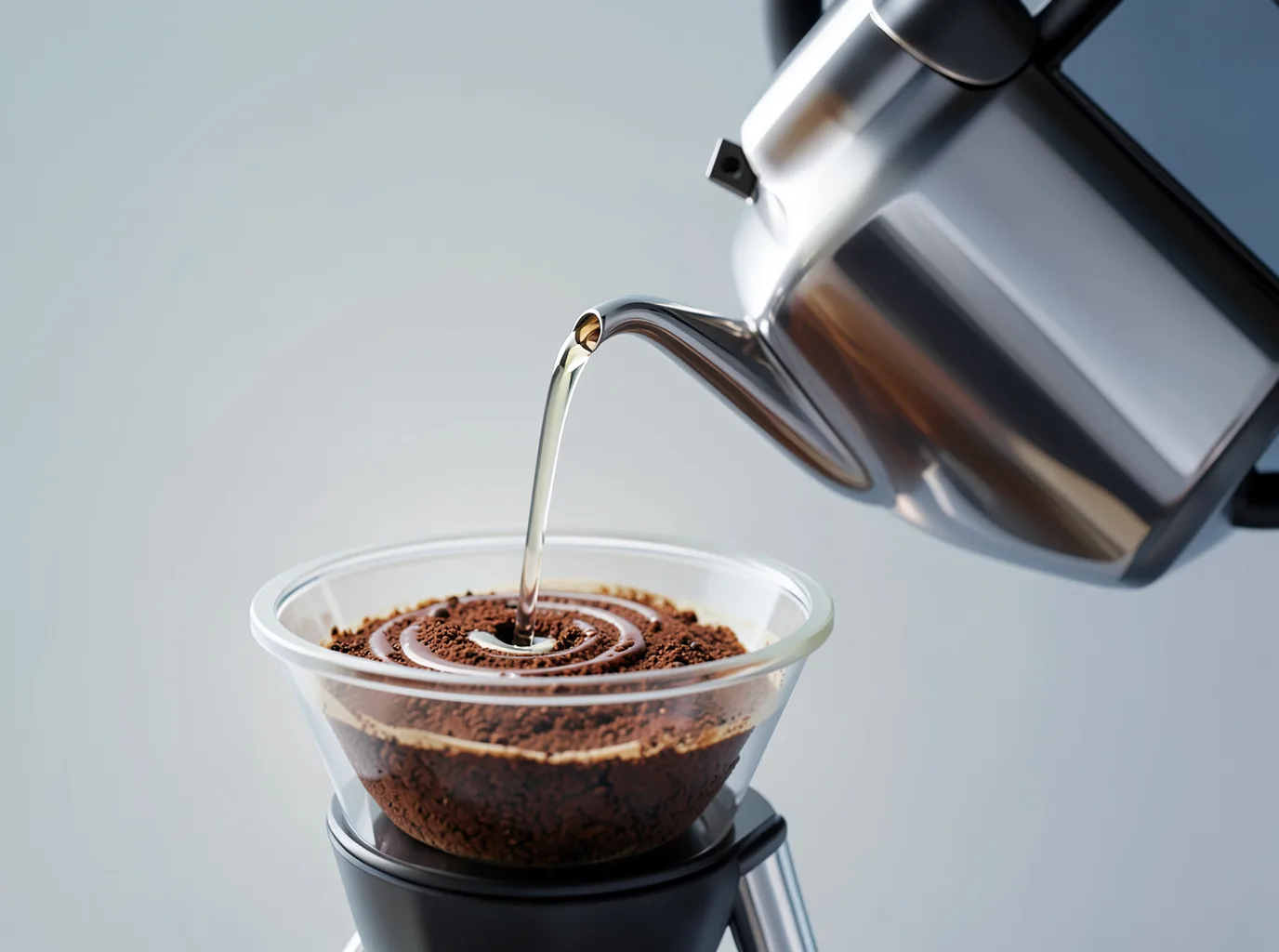
#Three-Stage Pour (Standard)
- Bloom: 30 ml (2× dose), 30 s, degas CO₂, level bed.
- Main Pour: 3–4 ml/s concentric circles to 150 ml, ~1:00–1:15.
- Final Top-Up & Drawdown: continue circles to 225 ml, finish 2:00–2:30, gentle swirl to flatten walls.
#Advanced: Pulse Pour
- 30–40 ml pulses, 5–8 s pauses; suits ultra-light or ultra-fine grinds, prevents bed collapse.
#Critical Micro-Details
- Impact Point: 1–2 cm above slurry, never directly on filter edge.
- Circle Radius: center → out → back, maintaining even water level rise.
- Final Swirl: two gentle clockwise rotations post-pour to erase wall height differential.
#Coffee Stylesheet: Printable Decision Card (Complete)
Save as image/PDF, post at your brew station:
| Module | Baseline | Adjustment Direction | Typical Flavor Signal |
|---|---|---|---|
| Ratio | 1:15 | Strong → less water/more coffee; Weak → more water/less coffee | Watery/salty vs thin/tasteless |
| Temp | 91 °C | Sour → +1–2 °C; Bitter → –1–2 °C | Sharp acid/floral vs char/smoky |
| Grind | Sea salt | Fast/sour → finer; Slow/bitter → coarser | Done < 2:00 vs still dripping > 3:00 |
| Bloom Water | 2× dose | Fresh beans → 3×; Aged beans → 2× | Vigorous dome vs flat/no gas |
| Pour Rate | 3–4 ml/s | Finer stream → longer extraction; Coarser → faster | Even bed vs cratered channels |
| Total Time | 2:15 ±15 s | Overtime → coarser/less water; Undertime → finer/more water | Balanced sweet vs sour/bitter imbalance |
Quick Diagnose
- Bright acidity, clear layers, long finish → parameters in window, bean quality high.
- Hollow, watery, no aftertaste → extraction < 18 % → finer / hotter / higher ratio.
- Bitter, dry, throat discomfort → extraction > 22 % → coarser / cooler / lower ratio.
#Advanced: From "Replication" to "Mood Customization"
Once the stylesheet becomes muscle memory, you can "mood-customize":
- Morning Wake-Up: Ethiopian light, 1:16, 93 °C, finer grind — capture jasmine/lemon high notes.
- Afternoon Focus: Colombian medium, 1:15, 91 °C, standard grind — balanced sweet-acid like background music.
- Evening Unwind: Mandheling dark, 1:14, 89 °C, coarser grind — heavy chocolate like cello bass.
CoffeeStyle's origin & flavor maps and wellness science feed this customization palette.
#Closing: One Cup, One Life Attitude
Pour over isn't showmanship; it's creating a controlled parameter space where terroir can speak. When the "Coffee Stylesheet" lives on your wall, every pour becomes a ritual confirmation: I command the extraction, and I command this slice of slow time. Next cup, swap in an origin you've never tried — same sheet, new flavor possibility.
#FAQ
#What is the pour over coffee ratio?
Baseline 1:15 (e.g., 15 g coffee to 225 ml water). Light roasts can stretch to 1:15.5–1:16; dark roasts tighten to 1:14–1:14.5. Fix dose, vary water — easiest to replicate.
#Which gooseneck kettle and dripper should a beginner buy?
We recommend the Hario V60 02 (ceramic or plastic) paired with the Hario Buono or Timemore Fish gooseneck kettle. The conical dripper offers fast, forgiving flow, while the kettle delivers a steady stream with a minimum flow rate ≤ 2 ml/s — ideal for learning precise pour control.
#How to adjust grind so coffee isn't bitter or sour?
Target 2:00–2:30 total time. Too sour/astringent → one click finer. Too bitter/drying → one click coarser. Change only grind per test; log time & flavor.
#What water temperature is best for pour over?
Light 92–93 °C, medium 90–92 °C, dark 88–90 °C. No PID kettle? Off-boil rest 30–60 s hits these zones. Winter: preheat all gear to cut 3–5 °C loss.
#Why is my pour over extraction always uneven?
Usually: off-center pour, erratic flow rate, unleveled bed, insufficient bloom. Fix with three-stage pour, concentric circles, steady 3–4 ml/s, final gentle swirl — dramatically improves flow uniformity.


