
Coffee Origin Flavor Profile Chart: Download, Print & Buy Beans with Confidence
TL;DR: This page delivers a coffee origin flavor profile chart you can download and print. It maps signature taste keywords for Ethiopia, Colombia, Panama, Yunnan and more, breaks down how processing, altitude, and variety weight flavor, includes a beginner buying guide with red-flag labels, and links each origin to the SCA Flavor Wheel for precise cupping vocabulary.
#Why You Need a Decision-Ready Coffee Origin Flavor Chart
Staring at a shelf of origin labels—Yirgacheffe, Huila, Geisha, Xiaozhong—most buyers default to gut feel or marketing copy. We covered the macro map in "Global Coffee Origin: Jamaica's Blue Mountain Region"; today the focus is turning origin data into buying decisions. This chart translates cupping-sheet jargon into the sensory coordinates you actually taste in the cup.
#Core Origin Flavor Keywords at a Glance (Print-Ready)
Distilled from recurring SCA cupping descriptors and typical terroir expression. Save as an image or print it for your brew bar.
| Origin | Signature Keywords | Dominant Process | Altitude (m) | Key Varieties | SCA Wheel Primary Groups |
|---|---|---|---|---|---|
| Ethiopia·Yirgacheffe | White floral, lemon, bergamot, tea-like | Washed > Natural | 1,700–2,200 | Heirloom, 74110, 74112 | Floral, Citrus Fruit |
| Ethiopia·Sidamo | Berry, black tea, tropical fruit, round acidity | Natural ≥ Washed | 1,500–2,100 | Heirloom, 74158 | Berry, Floral |
| Colombia·Huila/Antioquia | Caramel, red apple, nut, chocolate, bright acidity | Washed mainly | 1,400–2,000 | Caturra, Castillo, Typica | Nut/Cocoa, Fruit Acid |
| Panama·Boquete | Jasmine, peach, citrus, pristine clarity | Washed, Honey, Anaerobic Natural | 1,500–1,900 | Geisha, Typica, Caturra | Floral, Stone Fruit, Citrus |
| China·Yunnan·Baoshan/Pu'er | Dark chocolate, nut, spice, low acid, heavy body | Natural, Honey, Washed | 1,000–1,600 | Catimor, Typica, Yunka 1 | Cocoa/Nut, Spice |
| Kenya·Nyeri/Kirinyaga | Blackcurrant, tomato, grapefruit, high brightness | Washed (double ferment) | 1,600–2,100 | SL28, SL34, Ruiru 11 | Berry, Citrus, Vegetal |
| Costa Rica·Tarrazú | Honey, almond, citrus, strong balance | Honey, Washed | 1,200–1,900 | Caturra, Catuai, Villa Sarchi | Sugar Sweet, Nut, Fruit |
Usage tip: The "SCA Wheel Primary Groups" column maps to the inner ring of the Flavor Wheel. When cupping, lock the group first, then drill to level-two and level-three descriptors.
#How Processing Rewrites Origin DNA
Same origin, same variety, different process—two radically different cups. We break the mechanism into three levers:
#1. Natural / Dry Process — Fruit Sugars & Fermentation Metabolites Infuse the Seed
- Amplifies: Berry-like fruit acid, winey fermentation notes, body, lingering sweetness.
- Risks: Over-fermentation yields "alcoholic" or "rotten" notes; water-activity drift invites mold.
- Origin cases: Sidamo Natural → explosive blueberry/strawberry jam; Yunnan Natural → red wine, tropical fruit, chocolate finish.
#2. Washed / Wet Process — Strip Pulp & Mucilage to Reveal Pure Terroir
- Amplifies: Floral aromatics, citrus acidity, clarity, cup-to-cup consistency.
- Risks: Over-fermentation or water issues introduce phenolic or sour-ferment defects.
- Origin cases: Yirgacheffe Washed → white floral, lemon, green-tea texture; Kenya Double Washed → blackcurrant, tomato acid, piercing brightness.
#3. Honey / Pulped Natural — Retain Partial Mucilage for a Middle Path
- Yellow/Red/Black Honey reflects mucilage thickness and drying time.
- Typical profile: Honey sweetness, stone-fruit acidity, round body, softened acidity.
- Origin cases: Costa Rica Red Honey → almond, caramel, balanced citrus; Panama Geisha Black Honey → jasmine layered with mango/peach honey sweetness.
#4. Emerging Methods: Anaerobic, Carbonic Maceration, Yeast Inoculation
- Controlled microbial environments target specific metabolites (e.g., ethyl acetate for pear/nail-polish aroma; lactic acid for yogurt acidity).
- Buying advice: Start with "anaerobic washed"—high tension, relatively stable. Anaerobic naturals carry higher defect risk; suit advanced explorers.
#Altitude, Variety, Soil: The Real Weighting Hierarchy
Industry shorthand: "Flavor = 60% terroir + 30% process + 10% roast/brew." Useful macro, but for buying decisions use this heuristic weighting:
- Variety Genotype — Sets the flavor ceiling and skeleton (Geisha's floral gene, SL28's berry-acid gene, Catimor's disease resistance + chocolate base).
- Microclimate & Altitude — Every +100 m ≈ –0.6 °C; longer maturation = more sugar, finer acidity, higher density.
- Soil Minerals & Microbiome — Volcanic ash gives minerality & citrus; red clay leans sweet/heavy; limestone often yields white floral.
- Processing — With the above fixed, process acts as a "flavor palette" to amplify or reshape dimensions.
- Roast Curve & Brew Parameters — Final translation layer; light roasts preserve origin signature, dark roasts reconstruct caramel/cocoa.
Field mnemonic: Pick variety for character, read altitude for density, choose process for flavor direction, lock roast for final expression.
#Beginner Buying Guide: Origin-Based Decision Tree
#Step 1: Define Your Flavor Comfort Zone
- Bright floral/fruit acid, tea-like clarity → Target: Ethiopia Washed, Panama Geisha Washed, Kenya Washed.
- Rich jammy sweetness, heavy body, low acid → Target: Ethiopia Natural, Colombia Honey, Yunnan Natural/Honey.
- Balanced nut/chocolate, forgiving brew, high value → Target: Colombia Washed, Costa Rica Honey, Brazil Cerrado.
#Step 2: Decode Hidden Label Signals
| Label Keyword | Real Meaning | Red Flag |
|---|---|---|
| "Single Origin" | Only guarantees single geography—not variety purity or uniform process | Must still check variety, process, altitude, roast date |
| "Geisha" | Variety name, not origin-exclusive; grown in Panama, Colombia, Ethiopia, Yunnan | Verify origin + process; price gaps can hit 10× |
| "Specialty" | SCA cupping ≥ 80 pts | Still check roast date (ideal 7–21 days post-roast) |
| "Natural" | Whole-fruit dried | Alcohol/rot notes = processing defect |
| "Washed" | Depulped, fermented, washed, dried | Sharp acid without sweet return = under-washed |
#Step 3: Start a Bean Log
Every purchase: Origin–Variety–Process–Altitude–Roast Level–Roast Date–Brew Params–Personal Notes. Three months later you own a personal flavor atlas.
#Mapping Origins to the SCA Flavor Wheel
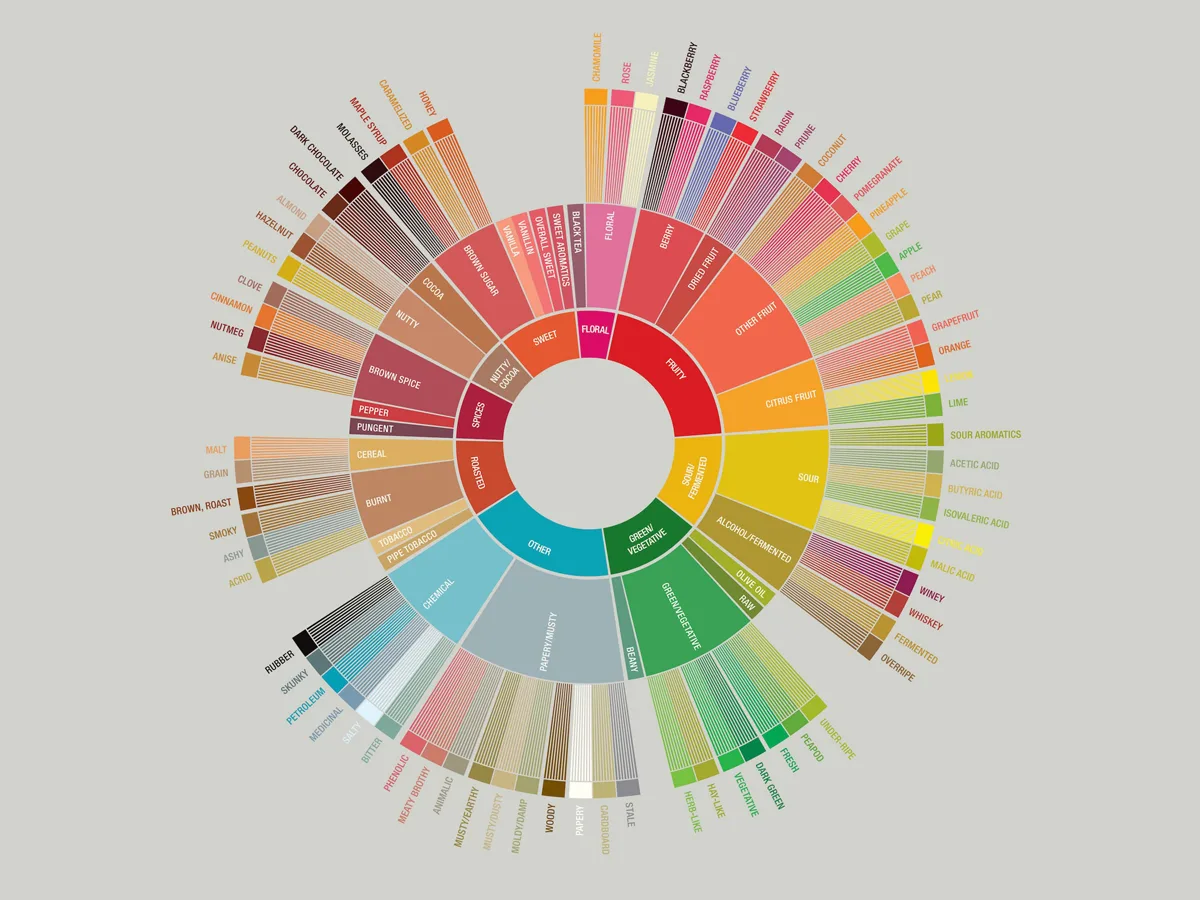
The SCA Flavor Wheel (2016) moves from inner ring (9 groups) → middle ring (sub-groups) → outer ring (specific descriptors).
#Origin → Wheel Path Quick Reference
| Origin Typical Note | Wheel Path (Inner → Middle → Outer) |
|---|---|
| Yirgacheffe Washed · White floral / Lemon / Tea | Floral → Floral → Jasmine / Citrus → Lemon / Green/Vegetal → Tea → Black Tea |
| Sidamo Natural · Blueberry / Strawberry / Red Wine | Fruit → Berry → Blueberry/Strawberry / Sour/Ferment → Alcohol/Ferment → Red Wine |
| Huila Washed · Caramel / Red Apple / Nut | Sweet → Caramelized → Caramel / Fruit → Stone Fruit → Red Apple / Nut/Cocoa → Nut → Almond |
| Panama Geisha · Jasmine / Peach / Bergamot | Floral → Floral → Jasmine / Fruit → Stone Fruit → Peach / Citrus → Bergamot |
| Yunnan Natural · Dark Chocolate / Nut / Spice | Nut/Cocoa → Cocoa → Dark Chocolate / Nut/Cocoa → Nut → Walnut / Spice → Allspice/Cinnamon |
| Kenya Washed · Blackcurrant / Tomato / Grapefruit | Fruit → Berry → Blackcurrant / Vegetal → Tomato / Citrus → Grapefruit |
Cupping workflow: Dry/wet aroma → lock inner ring group → first sip → confirm middle ring → finish → capture outer descriptors. Pair with the Coffee Flavor Profile Chart: A Bilingual Sensory Guide from Terroir to SCA Flavor Wheel to build sensory vocabulary faster.
#Closing: Tape the Chart to Your Brew Bar—Let Every Bean Choice Be Evidence-Based
Coffee thrives on "the dance of certainty and surprise." Terroir gives the certain baseline—Yirgacheffe's florals, Huila's caramel, Geisha's jasmine—while process, roast, and brew improvise the solo. This coffee origin flavor profile chart isn't meant to cage flavor; it's a foldable, annotatable, time-accumulating map.
Next steps:
- Download & print the tables (A4 double-sided, laminate for durability).
- Order two bags of the same origin, different process (e.g., Yirgacheffe Washed vs Natural), brew identical parameters, log the delta.
- Revisit your bean log quarterly; fill the chart's white space with your own annotations.
As we often say: One coffee, one lifestyle. When you can calmly say "This is a Yunnan Baoshan Catimor Natural, 1,450 masl, roasted 12 days ago, brewed 1:15 at 90 °C in a V60, yielding dark chocolate and walnut finish," the flavor map ceases to be a cold table and becomes your dialect with the world.
#FAQ
#What are the core flavor keywords for Ethiopia, Colombia, Panama, and Yunnan?
Ethiopia: floral, citrus, berry acidity. Colombia: caramel, nut, red apple, balanced. Panama Geisha: jasmine, peach, bergamot, extreme clarity. Yunnan: dark chocolate, nut, spice, low acid, heavy body.
#How does processing (Natural/Washed/Honey) rewrite origin character?
Natural retains fruit fermentation, boosting jammy sweetness and body. Washed removes mucilage for maximum terroir transparency and bright acidity. Honey keeps partial sugars for honeyed sweetness and rounded acid. Emerging anaerobic methods target specific metabolites for directed flavor amplification.
#What is the practical weight ranking of altitude, variety, and soil on flavor?
Variety sets the genetic ceiling (~30%). Altitude/microclimate drives sugar accumulation and acid finesse (~25%). Soil minerals impart minerality and unique fingerprints (~20%). Process acts as a flavor palette on the fixed base (~15%). Roast and brew finalize expression (~10%).
#What pitfalls should beginners avoid when buying by origin?
Beware vague "Single Origin" labels—always verify variety, process, altitude, roast date. Geisha is a variety, not an origin; confirm both. Specialty ≥ 80 pts still demands freshness. Natural coffees with alcohol/rot notes are defective. Washed coffees with sharp acid and no sweetness may be under-washed.
#How do I map specific origin descriptors to the SCA Flavor Wheel?
Start at the inner ring's 9 groups (Floral, Fruit, Nut/Cocoa, etc.), move to middle sub-groups (Berry, Stone Fruit, Citrus), then outer specific words (Blackcurrant, Peach, Bergamot). Example: Yirgacheffe Washed → Floral→Jasmine / Citrus→Lemon / Green→Black Tea. Use the bilingual flavor chart for guided practice.



Comments