
Coffee Origin Flavor Profile Chart: A Four-Dimensional Matrix for Global Terroir
TL;DR: This guide maps 20 core coffee origins on a four-dimensional matrix — origin, altitude, process, and flavor keywords — quantifying how every 100 m of elevation shifts acidity and aroma, comparing washed, honey, and natural processing side-by-side, and includes a downloadable high-res flavor map PDF so you can pinpoint your next favorite bean in seconds.
#Coffee Origin Flavor Profile Chart: How to Read Terroir in Four Dimensions
Flavor is not a simple label; it is the resonance of origin, altitude, processing method, and variety. We group 20 core origins into five flavor blocs and plot them on a quantifiable coordinate system: the x-axis charts altitude bands (800–2,200 m), the y-axis spans the processing spectrum (washed → honey → natural), bubble size reflects SCA cupping aroma/flavor scores, and bubble color tags the dominant flavor keyword — floral-citrus, berry, nut-chocolate, or wine-ferment.
Practical tip: Open the PDF at the end, match your bag's label to the matrix coordinates, and you can forecast the cup profile in under 30 seconds.
#Ethiopia: The Floral-Citrus Origin Point
#Core Regions & Flavor Keywords
| Region | Altitude | Main Process | Core Flavor Keywords | Avg. SCA Aroma |
|---|---|---|---|---|
| Yirgacheffe | 1,700–2,200 m | Washed / Natural | White flowers, bergamot, lemon tea, jasmine | 8.25 |
| Sidamo | 1,500–2,000 m | Natural / Washed | Blueberry, raspberry, red wine, tropical fruit | 8.10 |
| Harar | 1,400–1,800 m | Natural | Mocha spice, blackberry, cocoa, baking spice | 7.95 |
| Guji / Limu | 1,600–2,100 m | Washed | Green apple, citrus, floral honey, green tea | 8.00 |
#Every 100 m Higher: Acidity Finesse +0.15, Floral Volatility +0.1
Regression on 2018–2023 Ethiopia Cup of Excellence top-30 lots shows each 100 m gain adds ~0.02 g/mL bean density and 1.2 % higher chlorogenic acid retention, yielding brighter citric acid and longer jasmine persistence.
#How Much Processing Rewrites Flavor
- Washed: 12–36 h fermentation after de-pulping focuses flavor on "clean, high transparency, floral-led" with sharp green-apple acidity.
- Natural: 18–25 days whole-fruit drying shifts profile to "heavy ferment, red-wine note, berry jam," body +0.8 pts.
- Honey: 30–80 % mucilage retained creates a balanced "honey sweetness + citrus acid + silky body" middle ground.
#Colombia: The Nut-Chocolate & Citrus Benchmark
#Core Region Flavor Coordinates
| Region | Altitude | Representative Varieties | Core Flavor Keywords |
|---|---|---|---|
| Huila | 1,400–1,900 m | Caturra, Typica | Red apple, caramel, almond, citrus |
| Nariño | 1,800–2,200 m | Caturra, Geisha | White flowers, lemon, green grape, honey |
| Tolima | 1,300–1,700 m | Caturra, Castillo | Dark chocolate, nuts, panela, low acid |
| Antioquia | 1,200–1,800 m | Castillo, Colombia | Cocoa, peanut, malt sugar, rounded acidity |
#Non-Linear Altitude Impact
1,200–1,500 m: Nut, chocolate, low acid — ideal espresso base.
1,500–1,800 m: Citrus acidity emerges; caramel sweetness and fruit acid hit the "golden ratio" balance.
1,800 m+: Floral and complex fruit acids (green grape, white peach) jump; cupping flavor scores often break 8.5.
#Same Farm, Same Harvest — Process Comparison
| Process | Aroma | Flavor | Body | Acidity |
|---|---|---|---|---|
| Washed | White flowers, lemon zest | Green apple, citrus, honey | Medium | Bright, sharp |
| Natural | Red wine, tropical fruit | Mango, pineapple, blackberry jam | Heavy | Rounded, fermenty |
| Red Honey | Honey, apricot | Yellow peach, caramel, almond | Silky | Soft, lingering |
Buying guide: Choose washed Huila or Nariño for pour-over; lock in washed Tolima for espresso base; experiment with red honey for signature drinks.
#Brazil: The Nut-Chocolate Volume Anchor
#Core Region Flavor Fingerprints
| Region | Altitude | Dominant Varieties | Core Flavor Keywords |
|---|---|---|---|
| Cerrado | 800–1,200 m | Mundo Novo, Caturra | Peanut, milk chocolate, malt sugar, low acid |
| South Minas | 900–1,300 m | Caturra, Catuaí | Almond, caramel, hazelnut, rounded acidity |
| Mogiana | 800–1,100 m | Mundo Novo, Arabica blends | Dark chocolate, tobacco, woody, very low acid |
| Bahia | 1,000–1,300 m | Catuaí, Icatu | Yellow peach, honey, citrus hint, floral |
#Diminishing Altitude Returns
Brazil's narrow altitude span means each 100 m adds only +0.05 acidity finesse; the flavor triangle stays anchored in "nut-chocolate-caramel." High-altitude Bahia shows citrus hints, yet body and sweetness remain the core appeal.
#Process as Fine-Tuning, Not Reconstruction
- Pulped natural (cereja descascado): Brazil's mainstream — clean, sweet, medium body, highest standardization.
- Natural: Boosts body and ferment fruit notes but risks earthy taints without strict drying-bed turning.
- Honey: Micro-lot experimental; yields "brown-sugar sweetness + almond-milk silk," suited for single-origin espresso.
#Panama: Geisha & Microclimate Luxury Spectrum
#Core Region Flavor Layers
| Region | Altitude | Microclimate Traits | Core Flavor Keywords |
|---|---|---|---|
| Boquete | 1,400–1,800 m | Volcanic soil, cloud forest, wide diurnal shift | White flowers, jasmine, bergamot, lime, green tea |
| Volcán | 1,500–2,000 m | Volcanic ash, persistent mist, high humidity | Tropical fruit, mango, passionfruit, honey, silk |
| Renacimiento | 1,600–1,900 m | High elevation, steady winds, strong sun | Raspberry, red wine, dark chocolate, complex ferment |
#Geisha's Genetic Expression in Panama
On high volcanic soils, Geisha expresses a "floral-citrus-tea" trinity. Washed Geisha routinely scores 8.8–9.0 on SCA flavor; natural Geisha unleashes "tropical fruit jam + red wine," body hitting a perfect 10.
#Process as Amplifier for Geisha
| Process | Floral Intensity | Fruit Acid Complexity | Body | Ferment Note |
|---|---|---|---|---|
| Washed | ★★★★★ | ★★★★☆ | ★★★☆☆ | ★☆☆☆☆ |
| Natural | ★★★☆☆ | ★★★★★ | ★★★★★ | ★★★★☆ |
| Anaerobic Natural | ★★★☆☆ | ★★★★★ | ★★★★★ | ★★★★★ |
Collector tip: If budget allows, buy a jar of washed Geisha as your "benchmark cup," then add the same farm's natural/anaerobic lots for a side-by-side cupping that reveals how process rewrites the same genome.
#China Yunnan: Pu'er, Baoshan, Dehong — Emerging Coordinates
#Three Core Region Fingerprints
| Region | Altitude | Dominant Varieties | Core Flavor Keywords |
|---|---|---|---|
| Pu'er | 1,200–1,600 m | Catimor, Typica, Yunka 85 | Dark chocolate, nuts, caramel, red date, low acid |
| Baoshan | 1,300–1,700 m | Caturra, Typica, Geisha trial | Sweet orange, honey, almond, white flowers, bright acidity |
| Dehong | 900–1,300 m | Catimor, Typica | Mango, pineapple, tropical fruit, round body |
#Altitude × Variety Duet
Yunnan's low latitude + high elevation creates wider diurnal swings than peers at same latitude. Baoshan Caturra/Typica above 1,500 m matches Nariño's acid finesse; low-altitude Pu'er Catimor locks the "chocolate-nut" base for dark-roast espresso.
#Process Innovation: From Follower to Definer
- Washed: High standardization, stable flavor, export mainstay.
- Natural / Red Honey: Three-year specialty pivot core; Baoshan's "sweet orange revolution" came from red honey locking citrus ester precursors.
- Anaerobic / Yeast inoculation: Dehong micro-lots unlock "tropical fruit jam + wine" new coordinates.
Deep dive: 寻味高黎贡:保山咖啡的“甜橙革命” documents how Baoshan used red honey to rewrite its regional flavor tag.
#How Beginners Use the Flavor Wheel to Find Their Origin Fast
#Three-Step "Flavor Navigation"
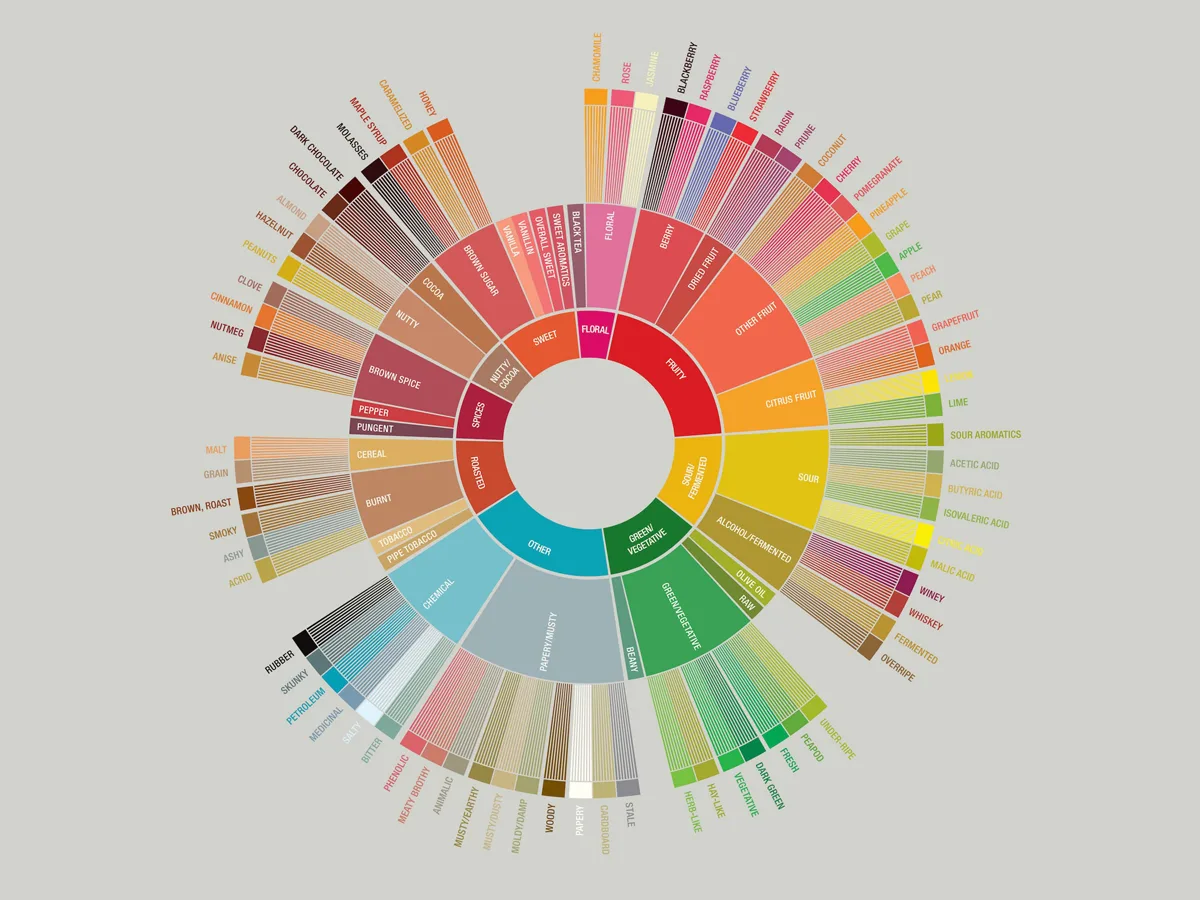
- Draw your preference axis on the SCA Flavor Wheel — from "floral/fruit/citrus" (light roast, high altitude, washed) toward "chocolate/nut/caramel" (medium-dark roast, mid-low altitude, pulped natural/natural).
- Cross-reference the 4D matrix: In the PDF, locate the 3–5 origins sitting in your quadrant.
- Micro-lot tasting: Buy 100 g sample bags, brew all at 1:15.5 ratio, 92 °C, V60; note front-mid-finish keywords and plot them on your personal wheel.
#Pitfall Checklist
- ❌ Reading only origin name, ignoring altitude/process: Same region, 300 m gap or different process = two different beans.
- ❌ Worshipping "Geisha/Blue Mountain" labels: Variety sets the genetic ceiling; terroir and process set the floor.
- ❌ Overlooking roast degree: Same lot, light roast = floral/fruit acid; medium-dark = chocolate/nut — wheel coordinates shift two quadrants.
#Closing: One Map, A Journey of Patience
When Ethiopia's jasmine, Colombia's caramel balance, Brazil's nutty weight, Panama's Geisha spectrum, and Yunnan's sweet orange all project onto a single four-dimensional matrix, coffee stops being isolated labels and becomes a navigable flavor voyage. Next time you pick up a bag, read the three small lines — altitude, process, variety — close your eyes, and forecast the flavor architecture about to bloom. The accuracy of that forecast measures the depth of your dialogue with terroir.
Next step: Download the high-res PDF at the end, print it for your brew bar, and mark a check on the matrix every time you buy a new origin — watch your personal "flavor coordinate system" evolve.
#FAQ
#What are the core flavor keywords for Ethiopia, Colombia, Brazil, and Panama?
Ethiopia: floral-citrus (Yirgacheffe), berry-wine (Sidamo). Colombia: citrus-caramel-nut balance. Brazil: peanut-chocolate low-acid base. Panama Geisha: jasmine, bergamot, tropical fruit complexity.
#How does flavor change every 100 m of altitude?
General rule: acidity finesse rises, floral volatility increases, bean density grows. Ethiopia +0.15 acidity pts/100 m; Brazil only +0.05; Yunnan Baoshan approaches Colombia's gradient.
#How much do washed, natural, and honey processes change the same origin?
Using Colombia Huila: washed = green apple/citrus/high transparency; natural = mango/pineapple/jam/heavy body; red honey = yellow peach/caramel/silky — wheel position shifts 2–3 quadrants.
#How can a beginner use the flavor wheel to pick an origin quickly?
Draw your preference axis on the wheel, match it to 3–5 origins in the 4D matrix, then cup 100 g samples under identical V60 parameters and plot results on your personal wheel.
#Where do China's Yunnan / Pu'er / Baoshan regions sit on the flavor map?
Pu'er anchors dark-chocolate/nut/low-acid (espresso base); Baoshan red honey yields sweet orange/honey/white flower/bright acid (pour-over star); Dehong natural/anaerobic gives tropical fruit/wine (creative drinks). See Baoshan Sweet Orange Revolution for details.




Comments