Coffee Price Forecast 2026: A Three-Factor Model and Monthly Range Outlook
TL;DR: 2026 Arabica ICE futures are projected to trade in a 185–235 ¢/lb range, Robusta at 2,400–3,100 $/t. The core drivers are Brazil’s “off-year” cycle overlapping with a fading El Niño, Vietnam’s dry-season export pacing, and speculative fund positioning. Roasters and cafés can lock in a cost ceiling while keeping downside upside via a layered “strip forwards + option collar” hedge.
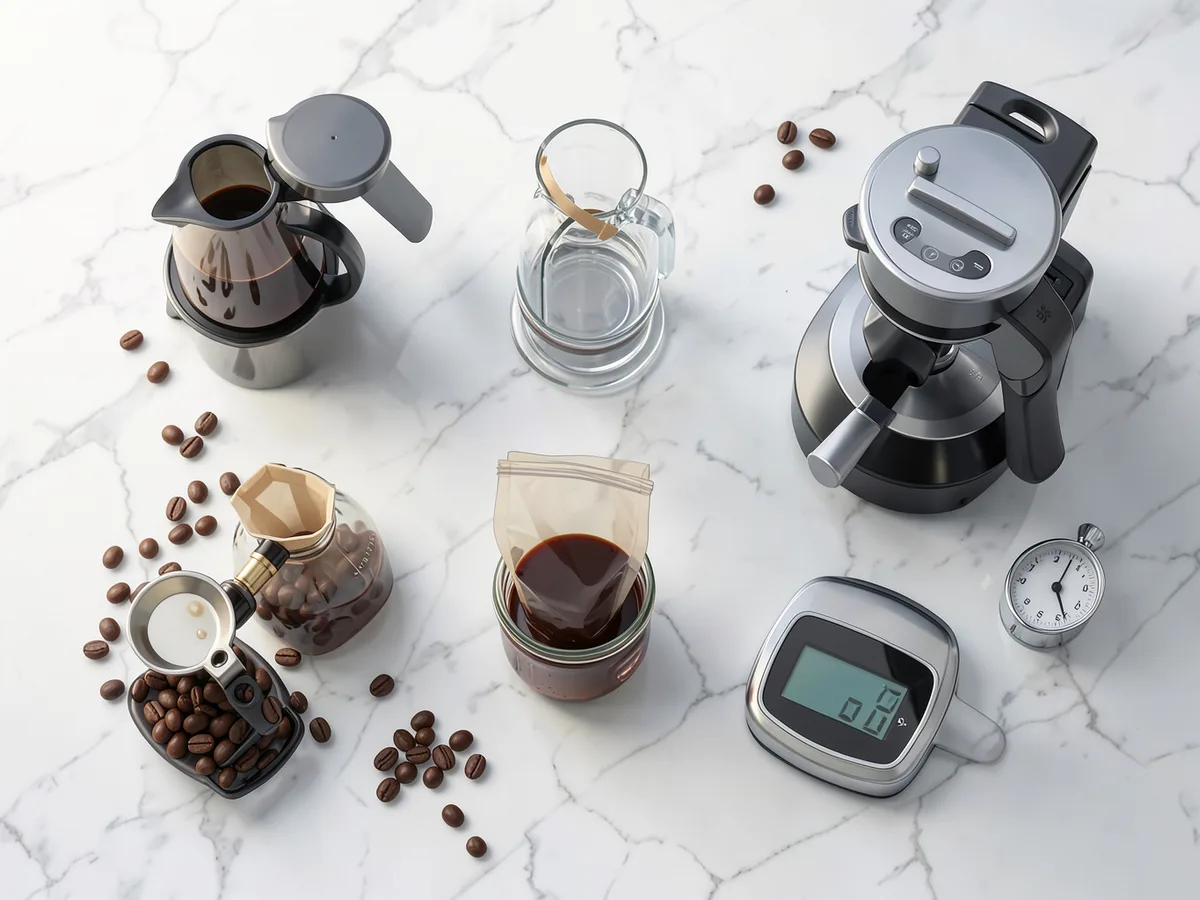
A cup of coffee, a way of life. As dawn light catches the steam rising from your pour-over, watch the water trace golden spirals through the bed — releasing jasmine, citrus, the quiet promise of terroir. Half a world away, the same forces shaping that flavor are writing the 2026 price story: afternoon thunderstorms over Minas Gerais, the dry-season wind across Vietnam’s Central Highlands, the queue of bulk carriers at Santos, the flickering cursors in Chicago. Our three-factor "Supply-Demand-Cost-Sentiment" model gathers these scattered notes into a score you can read — monthly ranges, hedge ladders, decision gates — so every roaster and café owner can brew with both poetry and precision.
#Will 2026 Arabica Futures Rise or Fall?
Prices will not trend in one direction but oscillate around a supply-demand equilibrium. Our three-factor model shows:
- Supply-Demand factor: Brazil enters the 2025/26 “off-year” with USDA forecasting a 3–8% drop, yet stocks are not fully cleared; Vietnam’s Robusta recovery partly offsets the Arabica gap. See 2025/26 Brazil coffee output seen down 3-8%, reshaping global market.
- Cost factor: The BRL/USD rate, fertilizer index, and Baltic Dry Index (BDI) form a “production + logistics” cost floor, seen at 170–180 ¢/lb in H1 2026.
- Sentiment factor: When CFTC non-commercial net longs exceed 80k contracts, a 10–15 ¢ overbought pullback often follows; a drop below 30k signals short-covering rallies.
Result: monthly settlement range 185–235 ¢/lb, with Q1 bias to the upside and Q3 correction risk higher.
#How Much Does Climate Change Affect Brazil/Vietnam Yields?
#Brazil: Fading El Niño Resonates with the “Off-Year”
- Key weather indices: Southern Oscillation Index (SOI), Minas Gerais Oct–Mar cumulative rainfall, frost probability from ECMWF ensemble forecasts.
- Quantified impact: If Oct–Dec rainfall is >20% below average, flowering suffers, cutting 5–8m bags; a subsequent June–Jul cold snap (<2 °C) could remove another 2–4m bags.
- Reference: Climate factors shaping Brazilian coffee cultivation documents historical cases.
#Vietnam: Dry-Season Length Sets Export Tempo
- Key indices: Central Highlands Nov–Apr rainfall, Mekong water level, flower-bud differentiation temperatures.
- Quantified impact: A two-week longer dry season ≈ -3% yield and advances exports by 4–6 weeks, lifting Q1 Robusta premiums.
#How Do Freight, FX, and Spec Money Feed Into Spot Prices?
| Transmission Path | Key Indicator | Typical Elasticity* | 2026 Watch Points |
|---|---|---|---|
| Freight → Landed Cost | BDI, SCFI South America lane | +0.12 ¢/lb per 100 BDI pts | Q2 peak season, Red Sea reroute premium |
| BRL/USD → Farmer Selling | BRL/USD spot | -0.8 ¢/lb per 1% BRL depreciation | BCB rate decisions, election cycle |
| Spec Net Longs → Basis | CFTC non-commercial net position | +0.05 ¢/lb per 1k net longs | Quarterly delivery months, risk-on/off shifts |

*Elasticities are historical medians; non-linearity amplifies in extremes.
Practical tip: Split procurement into three separate forwards — “FOB differential + freight + FX hedge” — and manage each leg independently.
#How Can Roasters/Cafés Lock In Prices?
#Step 1: Map Exposure & Horizon
- Tabulate next 12 months’ planned purchases by month; flag rigid base volume (e.g., signature blend backbone) vs flex volume (seasonal specials).
#Step 2: Build a “Strip Forwards + Option Collar” Stack
| Layer | Instrument | Share | Cadence | Goal |
|---|---|---|---|---|
| Base Hedge | ICE forwards / physical forwards (FOB Santos/Ho Chi Minh) | 60% | First week each month, rolling 3–6 mo | Cap cost, eliminate basis risk |
| Downside Protection | Put options or zero-cost collars | 30% | Start of quarter, strike = forward –5% | Keep upside participation |
| Strategic Reserve | Exchange stocks / bonded warehouse | 10% | Add when price < cost floor –5% | Physical buffer for extreme supply shock |
#Step 3: Run a Monthly Dashboard
- Must-track: ICE curve shape (contango/backwardation), Brazil port queue days, Vietnam GCA weekly exports, CFTC COT report (Fridays).
- Alert thresholds: Basis > +15 ¢/lb OR net longs > 90k → cut forward ratio, raise option share.
#How Useful Is the Yunnan Coffee Price Index?
The Yunnan Coffee Price Index (YCPI), published by the provincial agriculture bureau with the local exchange, tracks farm-gate prices for catimor, iron-pick, small-bean and other local varieties.
- Strengths: Captures China-origin micro supply-demand, state reserve signals, domestic roaster substitution intent.
- Limits: Small sample (<50 buyers), single-variety bias (mostly Catimor), no futures hedging tool, correlation with ICE only ~0.45.
- Advice: Treat as a supplementary signal, not a pricing anchor. If YCPI diverges >15% from ICE for three straight weeks, it may flag domestic tightness — consider early restocking.
#Closing: Brewing Certainty Inside Uncertainty
Coffee price swings resemble the turbulence and order of water threading a pour-over bed. We cannot know which leaf in Minas catches each raindrop, but we can box the uncertainty into manageable bands.
Next steps:
- Download the companion “2026 Coffee Hedge Template.xlsx” (monthly exposure calculator, collar pricer, KPI watchlist).
- Refresh variety/process cost drivers in Coffee Bean Basics You Must Know.
- Track demand-side structural shifts via Wall Street Journal: WFH splits the coffee market.
May every cup you serve carry both terroir’s gift and the calm of reason, bitter turning sweet in the end.
#FAQ
#Will 2026 Arabica futures rise or fall?
Expect a 185–235 ¢/lb two-way range. Q1 supported by Brazil flowering weather; Q3 pressured by new-crop arrivals. No sustained one-way trend.
#How much does climate change hit Brazil/Vietnam yields?
Brazil’s off-year plus fading El Niño could cut 5–12m bags; each extra two dry weeks in Vietnam trims ~3% yield and front-loads exports.
#How do freight, FX, and spec money affect spot prices?
Every 100 BDI points adds ~0.12 ¢/lb landed; 1% BRL depreciation pushes ~0.8 ¢/lb lower via farmer selling; 10k spec net longs lift futures ~0.5 ¢/lb.
#How should roasters/cafés lock prices?
Use a 60/30/10 layered hedge: 60% rolling monthly forwards, 30% quarterly put/collar protection, 10% physical buffer bought on dips. Monitor basis and COT alerts weekly.
#How reliable is the Yunnan Coffee Price Index?
It reflects China micro dynamics and policy cues but suffers from tiny sample, variety bias, no derivatives, and only 0.45 ICE correlation. Use as a side indicator, not a benchmark.