
Arabica vs Robusta Coffee: Beyond Stereotypes — Genetics, Flavor & Market Reality
TL;DR: Arabica and Robusta aren't "better vs. worse" — they're distinct species shaped by genetics. Arabica (tetraploid, 2n=44) offers delicate florals, bright acidity, ~1.2% caffeine, and shines as single-origin specialty. Robusta (diploid, 2n=22) packs ~2.2% caffeine, high chlorogenic acid, bold body, and when carefully processed and roasted light, delivers chocolate, nut, and caramel notes essential to espresso blends and premium instant coffee.
#Arabica vs Robusta Coffee: Starting from Genetic Origins
Of the 130+ Coffea species, only two dominate commerce: Coffea arabica and Coffea canephora (Robusta). Arabica arose from a natural hybridisation between Robusta and Coffea eugenioides followed by chromosome doubling — an allotetraploid with 44 chromosomes. Robusta remains diploid with 22. This ploidy gap drives differences in genetic diversity, disease resistance, and flavour-precursor metabolism.
- Arabica: Native to Ethiopia's southwestern highlands (1,000–2,200 m), needing cool, moist microclimates with wide diurnal swings.
- Robusta: Originates in the Congo Basin lowland tropics, thriving at 200–800 m with heat, humidity, and strong resistance to leaf rust and berry borer.
CoffeeStyle note: "Terroir" is a dialogue between genes and environment. For a deeper gene-to-cup comparison, see our Arabica vs Robusta Difference: A Deep-Dive Comparison from Gene to Cup.
#Chemical Showdown: Caffeine, Lipids, Chlorogenic Acids & Sugars
| Metric (dry-weight approx.) | Arabica | Robusta | Flavour / Physiological Impact |
|---|---|---|---|
| Caffeine | 1.1–1.5% | 2.0–2.7% | Robusta = stronger bitterness, higher alertness; sensitive drinkers take note |
| Lipids | 15–17% | 10–12% | Arabica's oils create silky mouthfeel and aroma retention |
| Chlorogenic Acids (CGA) | 5.5–8% | 7–10% | Higher CGA in Robusta yields more quinic/caffeic acids on roast → roasty bitterness |
| Sucrose | 6–9% | 3–5% | Arabica's sugar fuels richer caramelisation & Maillard reactions |
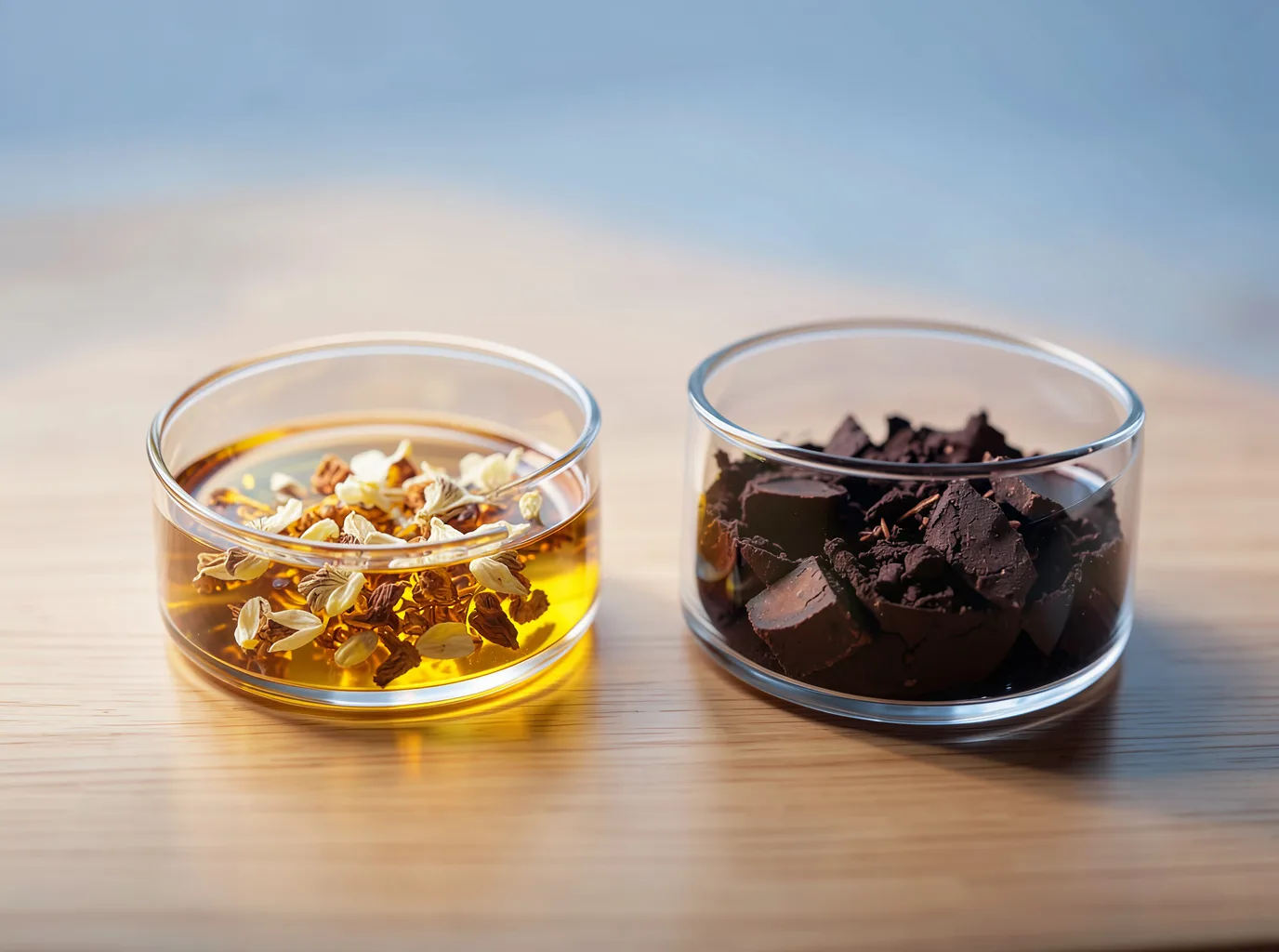
Key insight: Caffeine divergence stems from purine-pathway gene expression; lipid/sugar gaps underpin the "arabica floral/fruity, robusta heavy/bitter" stereotype. Yet washed/anaerobic processing plus light roasts can dramatically lift Robusta's sweetness and cleanness.
#Cupping Data & Flavour Maps: What SCA Scores Reveal
On the SCA cupping form, specialty arabicas routinely score 85–90+, balanced across aroma, flavour, acidity, body, and balance. Robusta historically sat below 80 due to ferment defects and harshness. Recent "Fine Robusta" lots (Vietnam washed, Brazil Conilon honey) processed and roasted light hit 82–84, showing:
- Typical Arabica: Jasmine, citrus, berry, tea-like, bright acidity, lingering sweetness.
- Quality Robusta: Dark chocolate, roasted almond, caramel, spice, low acidity, heavy body, persistent finish.
CoffeeStyle observation: Flavour isn't hierarchical — it's about "terroir expression" and "processing intent". Explore the arabica family tree in Essential Beginner Knowledge About Coffee Beans.
#Commercial Logic & Blending Philosophy: Why Espresso Needs Robusta
- Cost & Supply Stability: Robusta yields 30–50% more per hectare, lower agrochemical input, spot price typically 50–70% of arabica.
- Body & Crema: High CGA + low lipids under 9-bar pressure create fine, persistent crema — the "suspension" and "bite" in espresso.
- Flavour Complement: Arabica brings top-note florals/fruit; Robusta anchors chocolate/nut base. Common ratios 70/30 or 80/20; some Neapolitan-style 100% specialty robusta espressos exist.
- Instant & Functional Coffee: Freeze-dried instant, RTD bottles, high-caffeine sports drinks lean on Robusta for caffeine retention and antioxidant load.
Case reference: The 2023 World Brewers Cup winning recipe used 85% washed Brazil arabica + 15% washed India robusta, balancing bright acidity with deep sweetness.
#Buying & Brewing Guide: Match the Bean to the Moment
#Single-Origin Pour-Over / Drip: Choose Arabica
- Roast: Light to medium-light (Agtron 65–75) to preserve terroir-driven florals and fruit.
- Parameters: 1:15–1:16 ratio, 90–93 °C water, V60/Origami three-pour, target 19–21% extraction, TDS 1.30–1.45%.
#Espresso Base / Milk Drinks: Blend or Fine Robusta
- Blend Ratio: 70–80% arabica + 20–30% robusta (washed/honey, medium-dark Agtron 45–55).
- Extraction Target: 18–22 s for 30–36 g, 18–20% extraction, hazelnut crema that holds.
#Cold Brew / Signature Drinks / Instant: Robusta Value Play
- Cold Brew: Coarse grind, 1:10 ratio, 18–24 h at 4 °C → low acid, high body, great with milk or nitro.
- Premium Instant: Freeze-drying locks Robusta's chocolate-nut aroma; reconstitute for high-caffeine, low-acid convenience.
#Health Angle: Caffeine Sensitivity & Antioxidant Balance
- Caffeine Metabolism: CYP1A2 genotype sets speed; slow metabolisers should cap daily caffeine at ~200 mg (≈ 1 double-shot arabica-blend espresso or ½ cup pure robusta pour-over).
- CGA Antioxidants: Robusta starts higher, but darker roasts degrade CGA — light roasts preserve more antioxidant activity.
- GI Friendliness: Low-acid robusta cold brew or dark-roast arabica may suit reflux sufferers; individual response varies — start small.
#Closing: One Cup, One Way of Understanding the World
Dismantling the "arabica good, robusta bad" binary isn't about overturning classics — it's about letting each bean speak its genetic and terroir truth. Whether you're circling water at dawn or texturing milk to steam's hiss, that cup connects farmer, roaster, and your present mood in a ritual vessel. CoffeeStyle walks beside you on the flavour-map journey — next stop, try a specialty washed robusta and redefine "richness" in the bittersweet.
#FAQ
#Which has more caffeine, arabica or robusta?
Robusta contains roughly twice the caffeine of arabica (2.0–2.7% vs 1.1–1.5% dry weight), delivering stronger stimulation but also higher risk of jitters or insomnia for sensitive individuals.
#Why is arabica more expensive?
Arabica grows at higher elevations with lower yields, greater pest pressure, and higher farming costs; specialty markets also pay premiums for its nuanced flavour profile, while robusta's commodity nature keeps its baseline price lower.
#Can robusta taste good?
Yes. Washed, honey, or anaerobic processed robusta roasted light to medium can score 82–84 on the SCA scale, showing dark chocolate, roasted nuts, caramel sweetness, and a clean, heavy body with minimal acidity.
#What are the flavour differences?
Arabica leans floral, fruity, bright acidity, and lingering sweetness. Robusta leans chocolate, nut, spice, low acidity, full body, and a bittersweet finish. Processing and roast degree shift both profiles significantly.
#Are most instant coffees robusta?
Yes. Commercial instant, RTD, and high-caffeine functional beverages predominantly use robusta for its high extraction yield, caffeine content, cost efficiency, and decent flavour retention through freeze-drying.
Further reading: Arabica vs Robusta: A Gene-to-Cup Decision Map | Global Coffee Origin: Jamaica's Blue Mountain Region




Comments